Houseplant · Marantaceae
Peacock Plant
Goeppertia makoyana
Hand it warmth, humidity, and soft water, and the peacock plant rolls out some of the boldest leaves you can grow indoors.
Bright indirect
65–75°F · 18–24°C
USDA 11–12
12–24 in · 30–60 cm
Overview
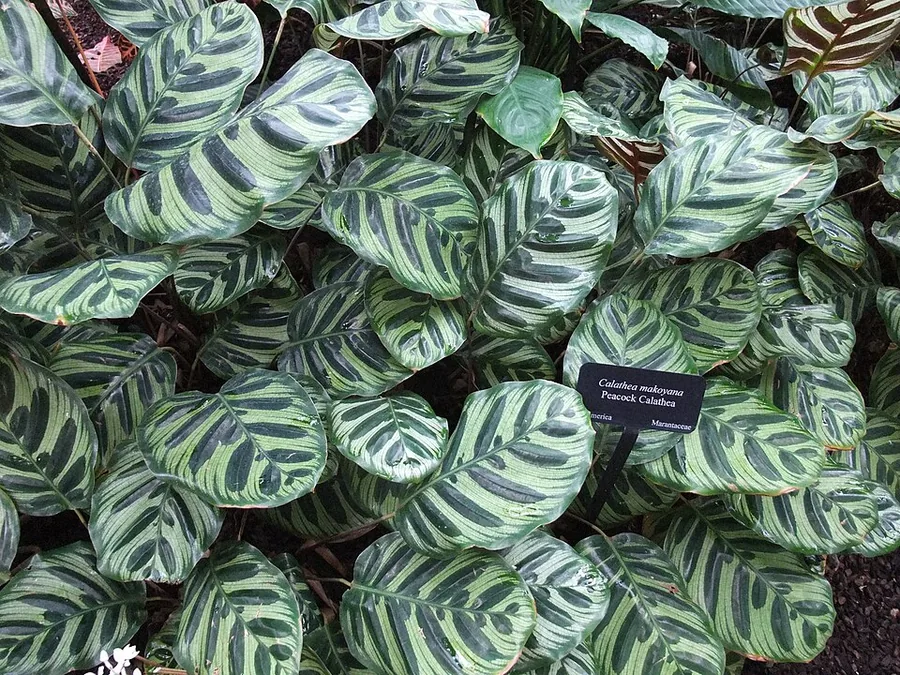
Every leaf explains the name. Bold green brushstrokes fan out from the midrib across a paler ground, backed by deep purple-red underneath, so each marking reads like the eye on a peacock feather. The plant sits in the prayer plant family, the Marantaceae, and traces back to the rainforest floor of eastern Brazil.
Like its kin, it moves. The leaves lift and fold up at dusk, then open again come dawn, a trait known as nyctinasty that lends the plant a quiet rhythm across the day. That rainforest origin also dictates how to grow it: warm air, steady moisture, and the dense humidity you'd meet beneath a forest canopy.
None of which makes it a starter plant. It runs fussy about water and dry air, and the moment either drifts off, it answers with brown leaf edges. Dial the conditions in, though, and few houseplants rival the patterning splashed across those leaves.
Care
The short version: bright indirect light, never direct sun, with soft water that holds the soil moist but never soggy, warmth in the 65°F to 75°F (18°C to 24°C) range, and humidity at 60% or higher.
Light
Hand the plant bright, indirect light, the sort it would catch a few feet off a window rather than parked on the sill. It will also accept part shade or even full shade, but direct sun scorches the leaves and drains the very pattern that earns it a spot.
Water
Hold the soil moist but never waterlogged through spring and summer, then back off as fall slides into late winter. Reach for distilled or rain water, since the fluoride in tap water browns the leaf edges. Pouring on too much is the quickest route to rotted roots.
Soil
Set it into a well-drained, humusy mix loaded with organic matter, with perlite stirred through to keep things airy. Steer the pH just under 8.0, and pick a pot that drains freely so the roots never sit in standing water.
Temperature
Keep the room between 65°F and 75°F (18°C to 24°C). This tropical native has zero patience for cold drafts, so park it well away from chilly panes and air vents.
Humidity
Humidity trips up most growers. The plant pushes for 60% or higher, and dry indoor air bites back fast with crisp brown edges, so a humidifier or a pebble tray usually pays for itself.
Feeding
Offer a balanced fertilizer monthly right through the growing season, spring into summer. Cut it off completely in winter, when growth idles and the plant puts the extra nutrients to no use.
Pruning
Pruning asks little of you. Clip away any damaged or browned leaves as they turn up, and run a damp cloth over the broad leaves now and then so dust doesn't dull them or steal their light.
Repotting
Aim to divide and repot roughly every two years, in late spring. That swaps in fresh mix and splits the rhizome in one go, which doubles as the way you raise new plants.
Size & spacing
It keeps a tidy frame, climbing to about 12 to 24 inches (30 to 60 cm) tall with a spread of 8 to 12 inches (20 to 30 cm). That small footprint slots it easily onto a shelf, a desk, or in among other humidity-loving plants.
Troubleshooting
Nearly every peacock plant complaint surfaces on the leaves, and the trail almost always leads back to water or air. Read the edges and the patterning and you can usually pin the cause before it spreads. Match what you spot below, then fix the condition driving it.
Drooping with mushy stem bases while the soil sits wet
A plant flopping over in soil that stays soaked points to root rot brought on by overwatering, not a lack of drink. Tip it out, snip off the brown, soft roots, and settle it into fresh, well-drained mix. After that, water only enough to hold the soil moist and never let it stay drenched.
Fix:
- Remove from wet soil and trim rotted roots
- Repot into fresh well-drained mix
- Water only to keep soil moist, never waterlogged
Fine webs and speckled yellow stippling turning up on the leaves
Bone-dry indoor air rolls out the welcome mat for spider mites, which spin thin webs across the undersides and pepper the surface with pale specks. Hose the foliage off, wipe each leaf clean, then hit them with insecticidal soap or horticultural oil. Crank up the humidity and the plant stops looking like a buffet to them.
Fix:
- Rinse foliage and wipe leaves
- Treat with insecticidal soap or horticultural oil
- Increase humidity to discourage mites
Crispy brown edges creeping in around the foliage
Those dry margins are tip burn, where fluoride, chlorine, and salts from the tap pile up in the leaf tissue, and parched air pushes it along faster. Swap over to distilled or rain water and drive the humidity to 60% or higher. Trimming the worst edges tidies things up, though the brown itself won't green back.
Fix:
- Switch to distilled water or rain water
- Raise ambient humidity to 60% or above
- Trim off badly browned margins for appearance
Washed-out pattern and bleached patches across the leaves
An overdose of direct sun burns the foliage and drains those peacock-feather markings down to a flat, pale green. Shift the plant back into bright indirect light or part shade, then strip away whatever leaves are badly scorched. Fresh growth comes in with the pattern restored.
Fix:
- Move the plant to bright indirect light or part shade
- Remove severely scorched leaves
Toxicity
Pet owners and parents can relax: the peacock plant is safe. The ASPCA lists Calathea as non-toxic to cats, dogs, and horses, and the leaves hold no harmful compounds for other animals or for people. Set it anywhere in the home and a curious nibble stays harmless.
Safe for
People · Cats · Dogs · Horses · Rabbits · Livestock · Birds
Cats None
The ASPCA rates this one non-toxic to cats, so an exploratory nibble does no poisoning. A cat that wolfs down any houseplant could still bring up the roughage, but nothing in these leaves is harmful.
Dogs None
Dogs have nothing to fear from it. The ASPCA marks the peacock plant safe for them, and the foliage carries no toxic compounds if a curious pup grabs a bite.
Horses None
A horse can graze right beside it without trouble, since both the ASPCA and NC State Extension list the plant as non-toxic to them.
Rabbits None
A rabbit takes no harm from the leaves. It isn't part of their usual menu, so an odd nibble does no damage while hay and greens stay the main diet.
Livestock None
Goats, sheep, and cattle won't be poisoned by this Marantaceae plant. Being a tropical houseplant, it seldom turns up where they roam in the first place.
Birds None
The peacock plant carries no toxins to bother a pet bird, so a beakful of foliage does no harm.
People None
Fine to grow in a home with kids around. People keep it for the leaves rather than the plate, but a stray mouthful poisons no one.
How to propagate
Making more peacock plants comes down to a single method, and it folds neatly into regular upkeep. You split the rhizome at repotting time instead of rooting a cutting.
DivisionModerate
Late spring · Several weeks to a few months to establish new growth
Multiplying this plant comes down to one move, dividing the rhizome, and it lines up perfectly with the repotting it asks for about every two years. Tackle it in late spring, teasing the root ball into clumps that each hang onto a handful of healthy shoots, then pot them up and hold them warm and humid. Settling in runs anywhere from a few weeks to a few months. Stem and leaf cuttings flat-out refuse to root.
Myths
The peacock plant is grown for its showy flowers.
Those tiny purple-to-white blooms slip by unnoticed and barely ever appear on a plant living indoors. The real show is the foliage, where the markings sweep over each leaf like the eye set into a peacock feather. Growers chase the leaves, not the flowers.
The peacock plant is toxic to pets.
Calathea sits on the ASPCA non-toxic list for cats, dogs, and horses, and NC State Extension repeats it for Goeppertia makoyana. You can keep this one in a house full of pets and not lose a wink of sleep.
Its correct botanical name is Calathea makoyana.
That label keeps showing up on nursery tags, yet it has dropped to synonym status. Kew lists the accepted name as Goeppertia makoyana, following the 2012 reshuffle that carried many Calathea over into the genus Goeppertia.