Houseplant · Marantaceae
Calathea Medallion
Goeppertia roseopicta
Hand it soft water, warm air, and steady humidity, and those medallion leaves unfurl with the whole painted pattern on show.
Bright indirect
61–75°F · 16–24°C
USDA 11–12
12–18 in · 30–46 cm
Overview
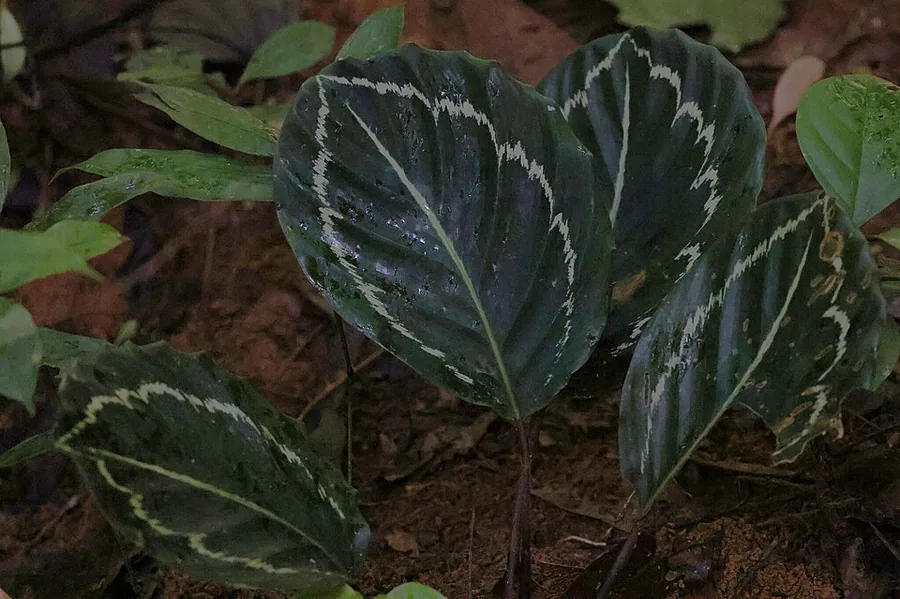
The Calathea Medallion gets its name from those big rounded leaves that look hand-painted, lime-green feathering over a darker base that flips to deep burgundy underneath. It sits in the prayer plant family and hails from the rainforests of South America, growing in the warm, shaded layer under the canopy. Come dusk the leaves fold upward like a pair of praying hands, a daily move known as nyctinasty.
Pick this one if you enjoy a bit of doting. It earns its demanding rating fairly: it craves warmth, steady moisture, high humidity, and water stripped of the fluoride and chlorine that pour from most taps. Nail those and it stays lush and deeply colored. Skimp and it lets you know quick, usually by throwing up brown, crispy leaf edges.
It keeps things compact, capping out around knee height and growing slowly, which makes it a natural for a shelf, a desk, or a humid bathroom with decent light. Keep it clear of direct sun, which scorches the leaves and fades that pattern. Land the right spot and you get foliage few other houseplants can touch.
Care
The short version: bright indirect light, never direct sun, and soil kept evenly moist with distilled water or rainwater. Hold the humidity above 60%, keep it warm, and feed monthly across spring and summer.
Light
Hand it bright, indirect light and keep it clear of direct sun, which scorches the leaves and bleaches the pattern. It copes with partial to full shade better than most, though starve it of light and the color goes flat. Park it near a bright window behind a sheer curtain and you have it dialed in.
Water
Keep the soil evenly moist but never soggy through the growing season, then back off and hold it just damp over winter. Water quality is the real sticking point, since this plant answers the fluoride and chlorine in tap water with brown tips. Reach for distilled water or rainwater instead.
Soil
Set it in a well-drained, peaty mix packed with organic matter, with vermiculite or perlite stirred in to keep it draining. A pH between 6.0 and 7.0, slightly acidic to neutral, sits right with it. The mix wants to grip moisture without ever turning waterlogged.
Temperature
Keep it warm, between 61°F and 75°F (16°C to 24°C). It has no patience for cold and wants a steady temperature of at least 61°F (16°C) all year, clear of draughts, open windows, and cold glass.
Humidity
This plant runs on humidity above 60% and protests with crispy leaf edges the moment the air dries out. Cluster it with other plants, set it over a pebble tray, or fire up a humidifier. A bright bathroom often serves up exactly what it craves.
Feeding
Feed monthly with a balanced liquid fertilizer across spring and summer while growth is rolling, then knock it off over the winter rest. Lean light rather than heavy, because spare salts gather in the soil and feed the brown-tip trouble.
Pruning
No real pruning to bother with. Just strip old leaves at the base as they yellow or brown, which keeps the plant neat and pushes its energy into fresh growth. Snipping a browned tip back to a thin margin is fine for looks.
Repotting
Repot every 1 to 2 years in spring, or sooner if roots circle the pot or shove through the drainage holes, bumping up just one pot size. This is also your cue to split the clump if you want more plants. Watch for stalled growth or quick drying as a hint it's outgrowing its home.
Size & spacing
It stays small, climbing to roughly 12 to 18 inches (30 to 46 cm) tall with a spread of 9 to 12 inches (23 to 30 cm). That slow, compact habit makes it a breeze to set on a shelf or desk without ever crowding the space.
Troubleshooting
Nearly every calathea hiccup turns up first on the leaves, and most loop back to water, light, or humidity. Catch the early tells and you can usually tackle the cause before it travels. Match what you spot below, then dial in the care that triggered it.
Yellowing, wilting foliage and a mushy crown
Let the soil sit soggy and root rot moves in, leaving the plant to flop even with a wet mix. Slide it out of the pot and read the roots, which go brown and mushy where they should be firm and pale. Cut away the rotted bits, repot into fresh well-drained mix in a pot with drainage holes, and pull back hard on the watering.
Fix:
- Stop watering and let the medium drain
- Unpot, trim away soft rotted roots, and repot into fresh well-drained mix
- Use a pot with drainage holes and water only when appropriate
Thin webbing and yellow-flecked, stippled leaves
Hot, dry air rolls out the welcome mat for spider mites, which cluster on the leaf undersides and trail faint webbing as they go. Tilt a leaf toward the light and you will spot it stippled with tiny yellow flecks. Hose down the foliage, crank up the humidity, and treat with insecticidal soap or horticultural oil, parking the plant away from the others until the mites clear out.
Fix:
- Rinse foliage and increase humidity
- Treat with insecticidal soap or horticultural oil, repeating as directed
- Isolate affected plant to limit spread
Brown, papery edges taking over the leaf tips
Here is the signature calathea grumble, and most of the time it traces back to fluoride and chlorine in tap water piling up inside the leaf tissue. Dry indoor air and salt left over from heavy feeding pile on. Switch to distilled water or rainwater, push the humidity above 60%, and rinse the pot through every so often to carry the salts away.
Fix:
- Switch to distilled water or rainwater
- Raise humidity above 60% with a pebble tray, humidifier, or regular misting
- Flush the soil periodically to leach out accumulated salts and avoid over-fertilizing
- Trim off badly browned tips for appearance
Bleached-out patches draining the leaf color
Pile on the direct sun and you get leaf scorch along with a washed-out medallion pattern. The damage lands on whichever leaves grab the most light, and brutal afternoon sun does the worst of it. Shift the plant into bright indirect light or partial shade, or string up a sheer curtain to take the bite off a bright window.
Fix:
- Move to a spot with bright indirect light or partial to full shade
- Avoid direct sun, particularly afternoon sun
- Filter strong light with a sheer curtain
Spots and blotches breaking out across the leaves
Separate spots and blotches signal leaf spot disease, which gets a foothold when the leaves stay wet and the air goes still. Aim your water at the soil rather than over the foliage, open up the room around the plant to keep air moving, and pluck off the marked leaves.
Fix:
- Avoid wetting the foliage when watering
- Improve air circulation
- Remove affected leaves
Toxicity
Great news for pet owners: the Calathea Medallion is safe. The ASPCA files Calathea and the prayer plant as non-toxic to cats, dogs, and horses, with no toxic compounds on record. A pet that chews a leaf might catch a mild, passing stomach upset from the roughage, same as any houseplant, but nothing here will poison an animal or a child.
Safe for
People · Cats · Dogs · Horses · Rabbits · Livestock · Birds
Cats None
Cats are in the clear, with no toxic principles on record. Should one chew a leaf, the roughage might leave it briefly queasy, and that is as far as it goes.
Dogs None
The ASPCA gives it the all-clear for dogs. A nosy pup can gnaw the foliage without harm, though a big mouthful might bring a brief spell of mild stomach upset.
Horses None
Rated non-toxic to horses, so there is zero poisoning risk if one takes a bite while grazing.
Rabbits None
Nothing in the leaves will poison a rabbit. Stick to the occasional nibble, since their gut runs best on its regular hay and greens.
Livestock None
No toxic compounds put grazers such as goats or sheep at risk, though as a tender tropical it rarely lands anywhere near them.
Birds None
The leaves hold no known toxins for birds, so a pet bird that perches or pecks among them faces no danger.
People None
Fine to keep around kids. Nobody grows it to eat, but a leaf that finds its way into a small mouth will poison no one.
As with any plant, ingestion of large amounts of foliage may cause mild, transient gastrointestinal upset that is not due to toxicity
Varieties
The Medallion name stretches across a couple of different species plus a few colorful kin in the same group. These are the ones you'll meet under that label.
Goeppertia veitchiana 'Medallion' (syn. Calathea veitchiana; 'Medaillon')
What usually reaches shelves as Calathea Medallion is logged by NC State and the RHS as Goeppertia veitchiana, sporting big rounded medallion leaves brushed lime-green and creamy-white up top over a deep burgundy underside.
Goeppertia roseopicta 'Medallion'
NC State Extension also files a separate Medallion pick under Goeppertia roseopicta, this one wearing silver-striped dark green upper leaves with purple undersides.
'Dottie'
A roseopicta pick set apart by a pink central vein that fans out across nearly black foliage.
'Rosy'
A roseopicta pick with bright pink leaf centers ringed by a slim green edge.
How to propagate
Just one path leads to a fresh Calathea Medallion, and it pays off reliably once you grasp what the plant will and won't do.
DivisionModerate
Late spring, typically at repotting during active growth · Several weeks to a few months for new divisions to root and resume growth
Division is your one ticket to more of this plant, since it flat refuses to grow from stem or leaf cuttings. Tackle it in late spring while growth is rolling, usually right at repotting, easing the rhizome clump apart into sections that each hold onto their own roots and shoots. Pack some patience for the new divisions, because they need anywhere from several weeks to a few months to root in and pick up growing again.
Myths
A calathea is every bit as toxic to pets as the other tropicals on the shelf.
This mix-up lumps calatheas in with their riskier tropical cousins. The ASPCA files both Calathea and the Prayer Plant as non-toxic to cats, dogs, and horses. You can grow this plant in a pet-filled home and rest easy.
Calathea Medallion really is a true-blue Calathea.
Most species once tagged Calathea, roseopicta and veitchiana among them, have since shifted into the genus Goeppertia. Kew gives the accepted name as Goeppertia roseopicta, holding Calathea roseopicta only as a synonym, so the old name carries on at the garden center rather than in botany.
Tap water is fine for a Calathea.
Calatheas and the rest of the prayer plants take the fluoride and chlorine in most tap water badly, and it surfaces as brown tips and edges. Distilled water or rainwater keeps the foliage clean, and that single swap clears up most leaf-tip browning.
Sources
- Plants of the World Online, Royal Botanic Gardens Kew
- NC State Extension Gardener Plant Toolbox
- Missouri Botanical Garden Plant Finder
- Royal Horticultural Society (RHS)
- Iowa State University Extension and Outreach
- ASPCA Animal Poison Control
- ASPCA Animal Poison Control
- NC State Extension Gardener Plant Toolbox
- Royal Horticultural Society (RHS)