Houseplant · Asphodelaceae
Gasteria
Gasteria
Hand it bright indirect light and a dry rest between waterings, and this tough little succulent just keeps thriving.
Bright indirect
Every 10–21 days
50–77°F · 10–25°C
USDA 10–12
Overview
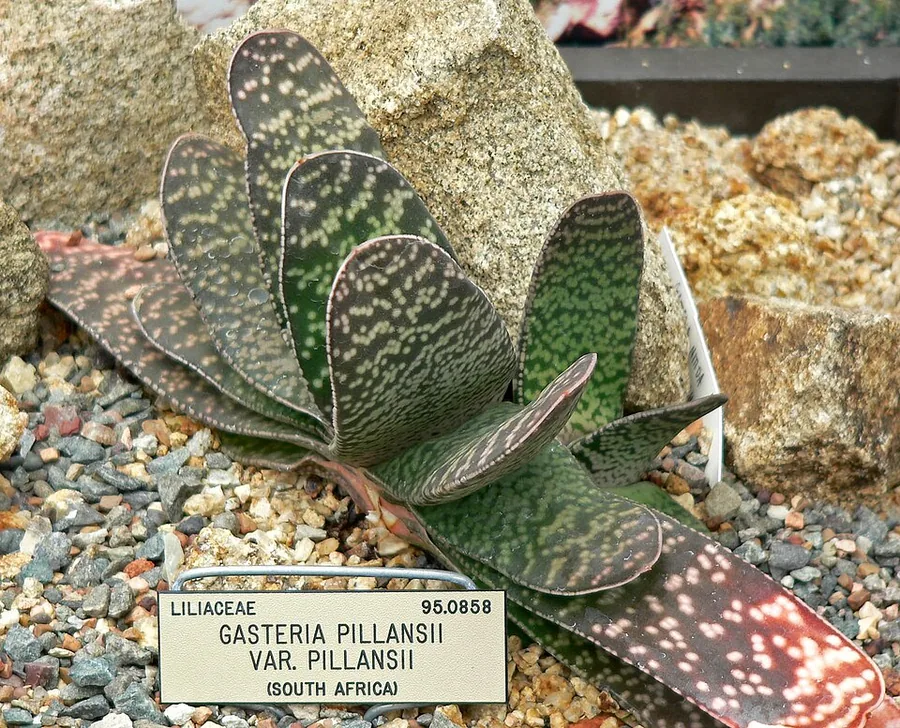
Gasteria packs a lot of character into a small package, growing thick, tongue-shaped leaves that earned it fun names like ox tongue and cow tongue. Those leaves stack up or fan into a low rosette, often speckled or studded with raised white bumps that beg a closer look. Best of all it stays compact, rarely topping a foot, so it slots onto a windowsill and rewards you every time you walk past.
It runs in the same family as aloe and haworthia, and that kinship shines through in the fleshy leaves and the arching flower spikes. Come spring and summer it can launch a slender stem strung with curved, pinkish tubular blooms that steal the show. It grows slowly and lives for years, steadily throwing out a clump of offsets around its base, so one plant turns into a whole little colony over time.
The real thrill is how much it gives back for how little it asks. Gasteria powers through lower and indirect light that would stall other succulents, laughs off a forgotten watering, and rarely bursts out of its pot. Just steer clear of one pitfall, soggy soil, and pretty much every part of growing it comes down to keeping those roots on the dry side.
Care
The short version: bright indirect light, a gritty fast-draining mix, and water only once the soil has dried out completely, keeping it nearly dry through winter.
Light
Gasteria thrives in bright indirect light and happily takes medium light or partial shade too, which puts it a step ahead of every sun-hungry succulent out there. Just keep it clear of harsh midday sun, since the leaves scorch when they jump into strong rays with no warning. Let the light drop too low and that crisp rosette stretches and flops, its way of asking for more.
Water
Let the soil dry out completely between waterings, then soak it deeply, which usually lands around every 10 to 21 days while it is growing. Dial it right back in winter and keep it nearly dry, giving just enough to stop the leaves shriveling. This one rots fast, so aim the water at the base and never let it puddle in the rosette.
Soil
Set it up in a gritty cactus or succulent mix that drains fast and holds zero standing water. That sharp drainage is the whole secret to keeping the rot-prone roots healthy, so if your mix feels dense, stir in extra perlite or coarse sand and it is ready to go.
Temperature
Keep it cruising in the 50°F to 77°F (10°C to 25°C) range, which normal room temperatures nail without any effort. It has no frost tolerance, though, so scoop it back inside well before the first cold nights hit.
Humidity
Gasteria wants low humidity and dry leaves, so the everyday air in your home is spot on. Ditch the misting entirely, since all it does is leave water sitting on the foliage and roll out the welcome mat for fungal trouble.
Feeding
Feed it lightly from spring into early autumn while it is actively growing, roughly once a month. Grab a dilute, low-nitrogen liquid cactus feed, then cut it off completely through winter once growth takes its break.
Pruning
Pruning barely registers here. Just peel off any dead, shriveled, or damaged leaves at the base, and snip the spent flower stalk once it wraps up blooming.
Repotting
Repot it every 2 to 3 years, or jump in sooner once offsets have crammed the pot. Bump it up to fresh gritty mix the moment roots start poking out the drainage holes or the soil dries out almost as fast as you water.
Size & spacing
This little dynamo tops out at just 4 to 12 inches (10 to 30 cm) tall with a spread of about 6 to 12 inches (15 to 30 cm). That compact size makes it a natural for a windowsill, a shelf, or a packed succulent dish.
Troubleshooting
Here is the great news: almost every gasteria hiccup traces straight back to water or light, so the fixes come quick. Soft leaves shout too much water, stretched growth flags too little light, and a couple of pests round out the lineup. Spot what matches below, then chase down the cause instead of the symptom.
Soft, see-through, mushy leaves
Soft, translucent leaves flag rot, and it almost always kicks off with too much water pooling in soil that drains poorly. Dig in and check the roots, and if they come up soft and blackened, slice away every rotted part and repot into fresh gritty mix. Then pull way back on the watering and let the soil dry out completely before the next drink, and it can bounce right back.
Fix:
- Stop watering and allow the soil to dry out
- Remove rotted tissue and repot into fresh gritty, fast-draining mix
- Resume only sparing watering once the soil is fully dry
White cottony spots or fine webbing on the leaves
Cottony fluff calls out mealybugs, and fine webbing means spider mites, and both burrow into the leaf bases where they are easy to miss. Swipe them off with a cotton swab dipped in rubbing alcohol and pull the plant away from its neighbors. If they charge back, hit them with insecticidal soap or horticultural oil and that settles it.
Fix:
- Wipe pests off with isopropyl alcohol on a cotton swab
- Isolate the affected plant
- Treat with insecticidal soap or horticultural oil as needed
Brown or reddish scorched patches on the leaves
Those patches spell sunburn, and they crop up when a plant grown in softer light gets thrown straight into hot, direct sun. Slide it back to bright filtered light and the fresh growth rolls in clean. When you do want to crank up the sun, ramp it over a week or two so the leaves toughen up first.
Fix:
- Move the plant to bright filtered or indirect light
- Acclimate gradually before increasing sun exposure
Stretched, pale, leggy growth
When light runs short, the rosette drops its tight shape and the leaves stretch and lean hard toward the nearest window. That is etiolation, and the floppy growth will not spring back into form. Shift it somewhere brighter, but ramp up gradually so you do not swap this problem for a case of sunburn.
Fix:
- Move gradually to brighter, indirect light
Toxicity
Pet owners can breathe easy, because gasteria is non-toxic and safe to grow around cats, dogs, and kids. It never made the ASPCA toxic list, and there is no poison lurking in the leaves. The worst a determined nibbler picks up is a mild, passing stomach upset from that tough, fibrous flesh.
Safe for
People · Cats · Dogs · Horses · Rabbits · Livestock · Birds
Cats Safe
A curious cat has nothing to fear here, since gasteria carries no toxins and a nibble will not poison it. The fibrous leaves are tough to digest, though, so a cat that really tucks in might drool or bring it back up.
Dogs Safe
Dogs can chomp the leaves with zero risk of poisoning. The worst a real mouthful is likely to trigger is a quick, passing upset stomach.
Horses Safe
Nothing in gasteria harms horses. It grows as a small windowsill succulent rather than pasture grazing, so the question almost never even comes up.
Rabbits Safe
The leaves are safe for rabbits and pack no toxins. That thick, fibrous flesh sits outside their normal diet, though, so keep it as the rare taste rather than a regular green.
Livestock Safe
Goats, sheep, and cattle face no poisoning risk from gasteria at all. And as a slow-growing potted succulent, it is hardly something they would ever get near anyway.
Birds Safe
Gasteria poses no toxic threat to birds. A pecked leaf does no harm, though the tough succulent flesh holds little a bird would actually want.
People Safe
The plant is non-toxic and safe to keep around children. Nobody grows it to eat, so there is no reason to put a leaf in the mouth, but a stray nibble does no harm.
Commonly regarded as pet-safe; even so, ingestion of fibrous succulent leaves may cause mild, transient gastrointestinal upset or vomiting in cats and dogs.
Varieties
Gasteria opens up a whole range of species and hybrids to explore, and a few keep popping up in collections for good reason. These are the standouts worth knowing by name.
Gasteria gracilis
A small clumping species with slender, tongue-shaped leaves that scored it the common names cow tongue and ox tongue.
Gasteria carinata var. verrucosa
The warty keeled ox tongue, loaded with raised white tubercles that give its leaves a rough, pebbled feel you cannot resist touching.
Gasteria glomerata
A compact species that packs itself into tight clusters of short, stubby grey-green leaves.
Gasteria 'Little Warty'
A crowd-favorite hybrid prized for its bumpy, marbled leaves and boldly pronounced warty texture.
How to propagate
Multiplying gasteria is a blast and about as easy as it gets, and half the time the plant does the heavy lifting itself by pumping out offsets you can lift and pot on.
Offsets & pupsEasy
Spring to summer during active growth · 4-8 weeks to root
The quickest win is to lift the offsets, or pups, crowding the base of the clump and pot each one up solo. Tackle it in spring or summer while the plant is charging along in growth, and the divisions grab hold and root in about 4 to 8 weeks.
DivisionEasy
When repotting in spring · 2-4 weeks
Once a clump crams its pot, split it into rooted sections at repotting time in spring. Every piece already comes loaded with its own roots, so it settles in fast and is usually growing again within 2 to 4 weeks.
Leaf cuttingsModerate
Spring to summer · Several weeks to a few months
You can also root a whole leaf taken in spring or summer. Let the cut end callus over for a few days, lay it on gritty mix, and wait it out, since it can run anywhere from several weeks to a few months and moves slower and less reliably than working with offsets.
SeedDemanding
Spring in warm conditions · Many months to years to reach size
Seed is the long game, sown in spring in warm conditions. Germination crawls and the seedlings need many months to years to build any real size, so growers reach for it to raise fresh variation rather than to bulk up plants in a hurry.
Myths
Gasteria is the same plant as the snake plant called mother-in-law's tongue.
They share a folk name and absolutely nothing else. Gasteria is a distinct Asphodelaceae succulent, while mother-in-law's tongue is a Sansevieria, now folded into Dracaena, so the two plants and their care have nothing in common.
Like its relative aloe, gasteria is toxic to pets.
Aloe does crack the ASPCA toxic list, but gasteria does not. Its toxicity has never been established, and growers keep it far and wide as a pet-safe succulent.
Misting keeps gasteria healthy.
This plant hails from dry country and wants low humidity with dry leaves. Misting just lets water sit in the rosette, which is exactly where fungal trouble and rot love to launch.