Houseplant · Asphodelaceae
Zebra Haworthia
Haworthiopsis attenuata
Give it bright indirect light and a good dry stretch between waterings, and this striped little succulent rewards you for barely lifting a finger.
Bright indirect
Every 14–21 days
50–77°F · 10–25°C
USDA 9–11
Overview
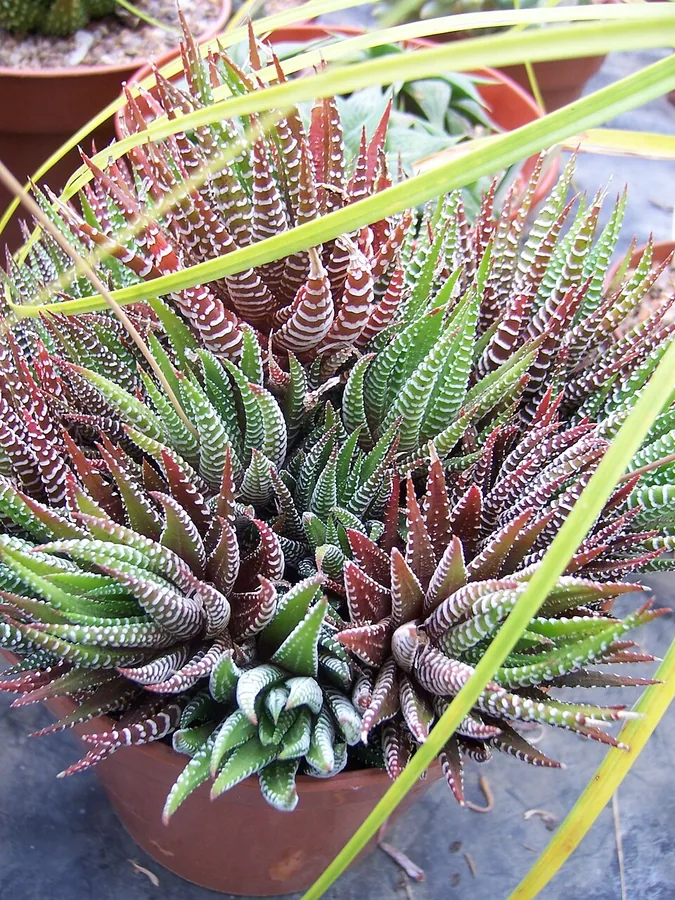
The zebra haworthia packs a lot of character into a tiny package. Those bold white stripes streaking across its dark green leaves are what earn it the name, and the stiff, pointed leaves stack into a crisp rosette that stays compact for life, rarely pushing past 4 to 6 inches (10 to 15 cm) wide. Slot it onto a windowsill, a desk, or a shared succulent dish and it holds that tidy shape year after year.
It hails from South Africa and belongs to the Asphodelaceae, growing wild in the dappled shade of taller plants instead of baking out in open desert. That backstory points straight to what keeps it thriving: bright indirect light beats scorching sun every time. Grow it on and a mature plant will shoot up a slender stalk of small tubular white flowers in spring or summer, a fun bonus on top of the striking foliage.
Here is what makes it such a rewarding grow: it practically thrives on being left alone. The thick leaves bank their own water, so it powers through a skipped watering and genuinely wants to dry out hard between drinks. Steer clear of just one thing, soggy soil, and this plant will keep going strong for years.
Care
The short version: bright indirect light, a gritty mix that drains in a flash, and a deep soak only once the soil dries out completely. Back off the water in winter, and this succulent takes it from there.
Light
Park it in bright indirect light, right near a window but out of the midday blast. It handles partial sun and medium indirect light just fine, but throw harsh direct rays at it and you will scorch the leaves and wash out that striking color.
Water
Drench the soil, then hold off completely until the mix dries out completely, which usually lands every 14 to 21 days. The thick leaves stash their own reserve, so erring dry beats erring wet hands down. Ease off hard in winter, when soggy soil rots the plant in no time.
Soil
Set it up in a gritty cactus or succulent mix that drains fast and never bogs down. A pH of 6.0 to 7.5 works great, which means the grit and texture of the mix count for far more than the chemistry.
Temperature
Regular room warmth keeps it cruising, ideally between 50°F and 77°F (10°C to 25°C). Just keep it clear of frost and cold drafts, since freezing is its one hard limit.
Humidity
This is a low-humidity champ, right at home in dry indoor air. Skip the misting and forget chasing a number, because damp, stagnant air only sets it back.
Feeding
It barely wants feeding, which keeps things easy. Across spring and summer, hand it a dilute, half-strength low-nitrogen cactus or succulent fertilizer now and then through the season. Cut it off entirely in autumn and winter while the plant rests up.
Pruning
Pruning is about as minimal as it gets. Strip off the withered outer leaves and clip any spent flower stalk at the base, and you are done. There is zero shaping or cutting back to fuss with.
Repotting
Repot just every 2 to 3 years, or jump on it sooner once pups pack the pot. The signals are easy to read: offsets crowding the rim, roots shooting out the drainage holes, or a mix that dries out almost the moment you water.
Size & spacing
This one stays small and neat, topping out around 4 to 6 inches (10 to 15 cm) tall and about as wide. A single rosette rules a small pot, and a whole crew of pups will happily bunk together in one shallow dish.
Troubleshooting
Nearly every hiccup with this plant traces straight back to water or light, and the leaves and rosette flag the trouble early. Spot the signs, match them below, and jump on the fix before it spreads. Most setbacks bounce right back.
Base leaves turning soft, mushy, and translucent
Soft, translucent leaves at the base scream root and crown rot, driven by water sitting in soil that drains too slowly. Cut the watering right now. Pull the plant, slice away every soft brown root with a clean blade, and let the cuts callus over. Replant in dry gritty mix, then water lightly only once it grabs hold again.
Fix:
- Stop watering immediately
- Remove the plant and cut away all soft, rotted tissue with a clean blade
- Allow cut surfaces to callus, then replant in fresh dry gritty mix
- Resume watering sparingly only once re-established
Stretched, pale growth with gaps opening between leaves
All that stretching is etiolation, the plant straining toward light it just is not getting. The tight rosette loosens up and tips hard toward the window. Move it into steady bright indirect light and spin the pot now and then so it packs back together evenly.
Fix:
- Move to a brighter location with bright indirect light
- Rotate the pot periodically for even growth
Leaves flushing red, orange, or bleached white
That color flare is sunburn, popping up on whichever side takes the strongest light, usually right after a jump to a brighter spot. Shift it back to bright indirect light and screen it from harsh midday sun. Craving a brighter home for it? Ramp up the exposure over a week or two so it can toughen up.
Fix:
- Move to bright indirect light
- Shade from intense midday sun
- Acclimate gradually to brighter spots over one to two weeks
Toxicity
Pet owners, great news: the zebra haworthia is non-toxic and pet-safe right through the household, cats and dogs included. It never turns up on the ASPCA toxic list, and nothing in those leaves will poison a curious muncher. The worst a determined chewer walks away with is a brief, mild stomach upset from the firm, chunky leaves, and that clears up fast.
Safe for
People · Cats · Dogs · Horses · Rabbits · Livestock · Birds
Cats None
Cats are totally safe around it, with no toxic reaction in play. Should one gnaw a few leaves, the worst it gets is a quick upset stomach, the same as any plant it should be skipping.
Dogs None
Dogs run zero poisoning risk here. A pup that chomps the firm rosette might drool or bring a bit back up from the sheer bulk, but nothing inside can hurt it.
Horses Safe
Nothing in it is toxic to horses, and as a small windowsill succulent it barely ever lands in their reach.
Rabbits Safe
Rabbits are safe with it too. The thick, tough leaves carry no toxins, though they hardly make a snack a bunny would chase.
Livestock Safe
Grazing animals like cattle, goats, and sheep have nothing to fear, since it packs no compounds that would trouble them.
Birds Safe
Pet birds are perfectly fine near it, because it holds nothing toxic, and those dense leaves are far too firm for most to bother pecking.
People Safe
It is harmless to people, kids included. Nobody grows it to eat, but a curious nibble does nothing worse than risk a mild stomachache.
Varieties
Only a handful of forms make the rounds, and they trip people up constantly, especially against the look-alike that hijacks the same common name. Here are the ones worth chasing down.
Haworthiopsis attenuata var. attenuata
This is the go-to form, showing off raised white tubercles that band clear across both the top and underside of every leaf.
Haworthiopsis attenuata 'Concolor'
This one scatters its white tubercles evenly all over the leaf instead of lining them up into the sharp stripes everyone pictures.
Haworthiopsis fasciata (true zebra haworthia)
Genuine fasciata keeps smooth inner leaf surfaces with tubercles only on the outside, but watch out: nearly every plant sold under that name is really H. attenuata.
How to propagate
Once it settles in, this plant hands you free copies of itself, and multiplying it is a blast. Pop off the pups crowding its base, or split a packed clump the next time you repot.
Offsets & pupsEasy
Spring to summer during active growth · 4 to 8 weeks to root once potted
The fastest way to multiply it is to grab the offsets, the pups piling up around the base of the parent. Take them in spring or summer while it is charging ahead in growth, let any cut surface callus, then pot each pup in dry gritty mix. Hit it with a light drink once it takes hold, and roots come racing in around 4 to 8 weeks.
DivisionEasy
At repotting in spring or summer · 4 to 8 weeks
You can also split a mature clump right when you repot in spring or summer. Break it into rooted chunks, keep each one dry until it establishes, and watch it settle in over roughly 4 to 8 weeks.
Myths
The zebra haworthia is just the zebra plant, Aphelandra, under another name.
Not a chance, these are two unrelated plants that only bump into the same nickname. This one is a small Asphodelaceae succulent with striped, fleshy rosettes, while Aphelandra squarrosa is a leafy Acanthaceae plant famous for big veined leaves and yellow bracts.
Zebra haworthia is a cactus that lives for full desert sun.
Nope, it is a succulent in the Asphodelaceae and not a cactus at all, and out in the wild it usually ducks into partial shade. Indoors it powers ahead in bright indirect light, while harsh direct sun just scorches the leaves.