Ornamental · Pontederiaceae
Pickerelweed
Pontederia cordata
A hardy native pond marginal that fires up blue flower spikes all summer, asking only for full sun and wet feet.
Full sun
USDA 3–10
2–4 ft · 0.6–1.2 m
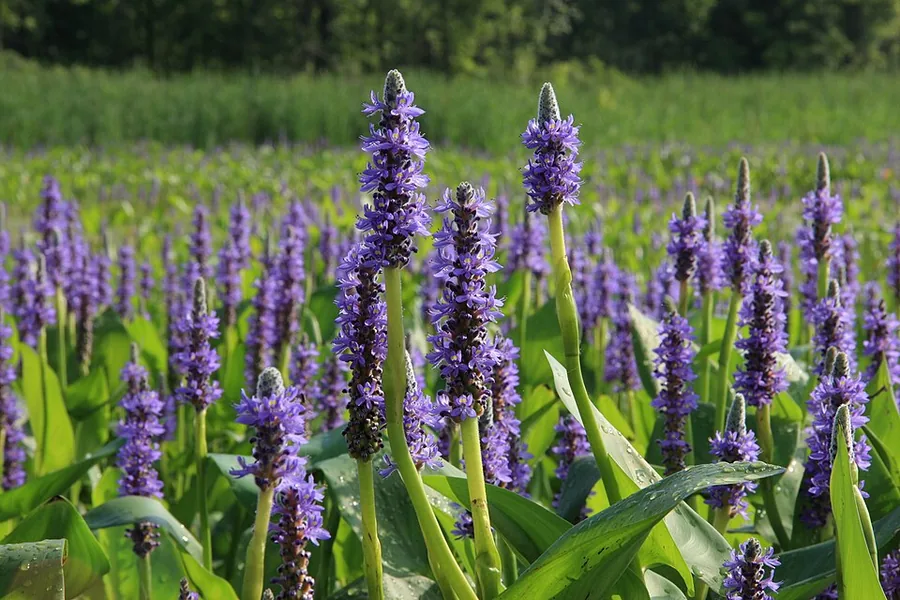
Overview
Pickerelweed lights up the edges of ponds, ditches, and slow streams across much of North America, a native aquatic that grows with real gusto. It digs into the mud at the water's edge and thrusts its leaves and flower spikes clear of the surface, the trick that makes it an emergent marginal. Glossy, heart-shaped leaves build the base, and from early summer into fall it sends up soft spikes of violet-blue flowers that keep coming.
It pulls a crowd of wildlife, too. The flowers draw bees and other pollinators, and ducks and waterfowl chase the seeds and foliage. As a hardy perennial it powers through winters from zone 3 all the way to zone 10, dying back in fall and charging up again from the rhizome each spring.
Two things decide how it goes. Keep the roots constantly wet to shallowly submerged, since this wetland plant will not take drying out, and know that the same drive that packs a pond edge with bloom will run if you let it loose. Grow it in a basket where space is tight and it stays a generous, well-mannered clump you will love watching fill in.
Care
The short version: hand it full sun and keep its feet wet, rooted in rich mud or loam with the crown under just a few inches of water, and pen the rhizomes in a basket so they don't take over.
Light
Pickerelweed cranks out its best bloom in full sun, where you rack up the most spikes and the strongest growth. It will take partial shade, but that trade costs you flowers and gives you a looser, leggier plant.
Water
This is a true wetland plant, so keep the roots constantly wet to shallowly submerged and never let them dry out. Root it in mud or rich loam under about 2 to 12 inches (5 to 30 cm) of water over the crown, or in boggy soil right at the water's edge. Just do not sink it deeper than roughly 12 inches (30 cm), because piling that much water over the crown can kill it.
Soil
Root it in rich organic loam or mud that stays constantly wet to submerged. It shrugs off pH worries, settling in anywhere from 6.0 to 8.0, so most pond mud gives it exactly what it needs.
Temperature
Pickerelweed is one tough customer, riding out everything from -40°F (-40°C) in winter dormancy up to about 100°F (38°C) in summer. That range spans zones 3 through 10, so it overwinters in place across most of the country.
Humidity
Growing right in or beside water, it never runs short on moisture in the air, so humidity is one less thing to chase. The high humidity at a pond edge is exactly where it takes off.
Feeding
It asks for barely any feeding and mostly fends for itself. Want to push more growth? Work an aquatic plant tablet into the soil during the spring-through-summer season, but keep it light, since this plant motors along on its own.
Pruning
Upkeep is a breeze. Snap off the spent flower spikes through the season, then cut back and clear away the old, dead foliage in late fall or early spring before the new growth surges.
Repotting
Every 2 to 3 years, lift the plant to divide and re-energize a crowded clump. It signals it is due when rhizomes bulge the basket, leaves shrink with fewer flowers, and the plant heaves up out of its pot.
Size & spacing
Plants shoot to 2 to 4 feet (61 to 122 cm) tall and spread 18 to 24 inches (46 to 61 cm) across. Give each clump room to widen, and remember the rhizomes will keep charging past that spread unless a basket reins them in.
When to plant
Pickerelweed runs on the warm season. Set divisions or potted plants out in spring once the frost has cleared, into mud at the pond margin or a submerged basket, and it fires back blue spikes from early summer straight into fall.
Northern hemisphere
Southern hemisphere
Typical months for a temperate climate: start earlier in warm zones, later where spring frosts linger.
- Sow: Late winter to early spring; seed germinates best under water and may need cold stratification
- Plant: Spring, after frost, into mud at pond margins or in submerged baskets
- Harvest: Early summer into fall (about June to October)
Hardiness
USDA hardiness zones: 3–10
Temperature: down to -40°C
Troubleshooting
Here is the fun part: pickerelweed carries no serious pests or diseases, so nearly all of its trouble narrows to two things, that it spreads and that it must never dry out. Match what you see below and you can jump on it before it runs too far or fades.
Wilting and browning from drying out or wrong planting depth
This is a wetland plant through and through, and drying out is the one thing that stops it cold, even once. Let the soil go dry or only damp, or bury the crown under more than a foot of water, and it browns and stalls fast. Keep that soil constantly wet to shallowly submerged, dial the depth back so only 2 to 12 inches (5 to 30 cm) of water covers the crown, and watch it bounce right back.
Fix:
- Keep the soil constantly wet to shallowly submerged at all times
- Reset the planting depth so only about 2-12 in (5-30 cm) of water covers the crown
- Move container plants to a shallower shelf or raise them on bricks
Spreading rhizomes that crowd a small pond or container
Pickerelweed loves to run, powering through open mud on thick rhizomes and packing out dense colonies that surge into open water and over their neighbors. Get ahead of it and drop it into a submerged aquatic basket right from planting, so the roots grow exactly where you want them. Then lift and divide the clump every 2 to 3 years, and clip back any escaping shoots to keep that energy on your terms.
Fix:
- Grow in a submerged aquatic basket or container rather than open mud to confine the rhizomes
- Lift and divide clumps every 2-3 years, discarding excess rhizome
- Pull or cut back outlying shoots to keep the colony in bounds
Minor leaf feeding from aphids, mites, or caterpillars
Here is a real perk: pickerelweed shrugs off trouble with no serious pests or diseases, so anything that shows up stays minor. Scan the leaves for clusters of aphids, the fine webbing and stippling of spider mites, or margins caterpillars have chewed. Blast the small pests off with a strong jet of water, pluck the caterpillars by hand, and let this tough grower power past the rest, which it does with ease.
Fix:
- Hose pests off with a strong jet of water
- Hand-pick caterpillars
- Tolerate minor damage, since this plant has no serious insect or disease problems and usually outgrows it
Toxicity
Pet owners and gardeners can dive right in, because pickerelweed is non-toxic to people and animals, and parts of it are even edible. The young leaves and ripe seeds have long been eaten, and the plant fuels ducks and other wildlife besides. Since it grows in standing water, the only real call is the usual supervision around a pond.
Safe for
People · Cats · Dogs · Horses · Rabbits · Livestock · Birds
Cats None
Great news for cat owners: a curious nibble of the leaves brings zero poisoning. The pond water is the only thing that calls for a normal watchful eye.
Dogs None
Dogs are in the clear, since the plant packs no toxic compounds. A mouthful of foliage leaves them in no danger from the pickerelweed itself.
Horses Safe
Horses can crop the leaves at a pond edge and come away just fine, because nothing in the plant is poisonous to them.
Rabbits Safe
The tender leaves suit rabbits perfectly and carry no toxins, making this a fuss-free marginal to plant near a hutch or pond.
Livestock Safe
Cattle, goats, and sheep can browse it safely. The plant is non-toxic and even fuels a whole range of grazing and wild animals.
Birds Safe
Better than harmless, the seeds and foliage are a top pick for ducks and other waterfowl, and they pose no risk at all to backyard or wild birds.
People Safe
People win here too, since the young leaves and seeds are edible. Cook the young leaves like a green and dig into the ripe seeds raw or roasted.
No special handling precautions; the plant is safe and even edible. It lives in standing water, so normal supervision around ponds applies.
Varieties
The straight blue-flowered species is what most gardeners grab, but a couple of selections are worth chasing down.
'Alba'
Chase a crisp white show and this selection delivers, launching tall spikes of white blooms from summer into fall instead of the usual blue.
var. lancifolia
This form swaps the heart-shaped foliage of the typical plant for slimmer, lance-shaped leaves.
Companions
Pickerelweed plays well with other native marginals and pond plants that share its taste for full sun and wet ground, layering the pond edge with different heights and leaf shapes.
Plant near
Water lily (Nymphaea): A classic pond pairing: pickerelweed's vertical blue spikes at the margin complement floating-leaved water lilies in deeper water.
Arrowhead (Sagittaria latifolia): Another native marginal sharing the same shallow-water, full-sun habitat for a layered pond-edge planting.
How to propagate
There are two ways to crank out more pickerelweed, and one races ahead of the other.
DivisionEasy
Spring · One growing season
Division is the fast, sure-fire way to build up more pickerelweed, so start here. In spring, dig an established clump and split those thick rhizomes into pieces, keeping roots and a shoot on each one. The new divisions dig in and bulk up over a single growing season, and away they go.
SeedModerate
Late winter to spring · One to two growing seasons
Seed rewards a bit of patience and takes off best when sown from late winter into spring. Germination fires strongest under water, even after dry storage, and a spell of cold stratification gives it an extra push. Give seed-grown plants one to two growing seasons to hit a good size, and they will get there.
Myths
Pickerelweed is the same plant as water hyacinth and just as invasive.
Set the record straight, because these are two different plants. Native pickerelweed digs into pond mud and holds its ground, while water hyacinth floats free and has a notorious knack for choking waterways. They both land in the family Pontederiaceae, but pickerelweed is a well-behaved native, not the invasive floater.