Ornamental · Saxifragaceae
Foamflower
Tiarella cordifolia
A shade native that rockets up frothy white spires each spring and spreads into a lush green carpet the rest of the year.
Partial shade
Every 3–7 days
USDA 3–9
5–12 in · 13–30 cm
Overview
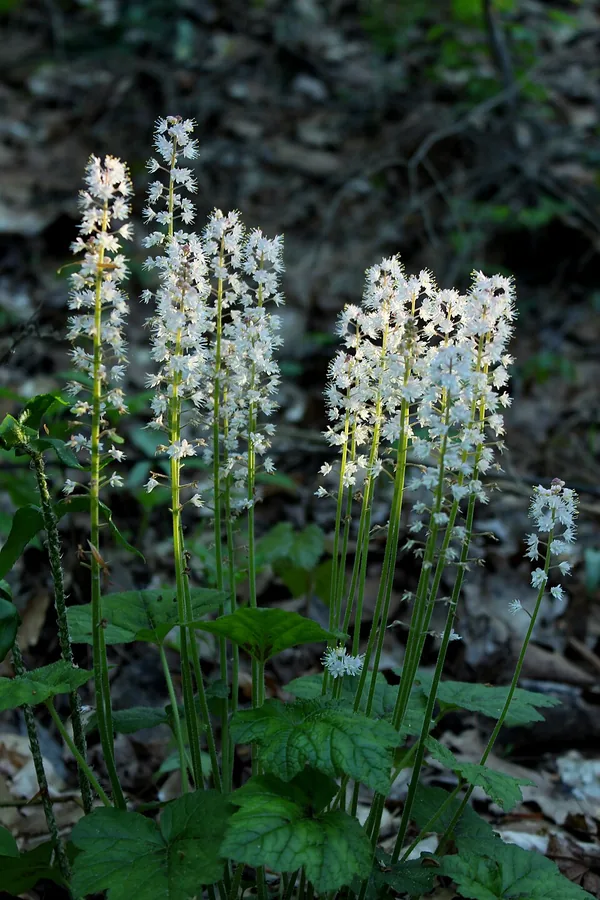
Foamflower puts on a real spring show, and it is a joy to grow. As the season warms, up come slim spikes packed with tiny flowers, white flushing to pink, hovering over the leaves like a cap of foam that gives the plant its name. This woodland native of eastern North America belongs to the saxifrage family, and it takes off across the ground on rhizomes and stolons, weaving fast into a low, leafy carpet.
The heart-shaped, lobed leaves keep the excitement going all year. They hang on as semi-evergreen foliage deep into winter, and plenty of forms fire up with bronze or deep red veining as the cold rolls in. Rugged across USDA zones 3 to 9, it keeps flowering in the dense, dry shade that stops most bloomers cold, which makes a tough corner suddenly full of promise.
Its wish list is short and sweet: shade, steady moisture, and rich woodland soil. Hand it those and it runs with them, spreading wider every season on its own steam. Deer skip right over it, the pest list barely registers, and once a clump bulks up you can split it every other spring for a fresh batch of free plants.
Care
The short version: plant it in part to full shade, keep rich humusy soil evenly moist, drain it well through winter, and barely feed it at all in good woodland ground, and it takes off from there.
Light
Drop foamflower into part shade to full shade and it thrives. It is a true woodland plant, right at home under trees or along the shady north side of the house, and it is one of the rare flowering ground covers that keeps delivering in heavy shade.
Water
Keep that soil consistently moist and never let it dry out, because this plant has zero drought tolerance. A soak every 3 to 7 days covers most spots, but dial it back in winter, since soil left wet through the cold can take out the crown.
Soil
Load it into rich, humusy soil that grips moisture yet still drains, the loose leaf-litter of a forest floor. Hit a pH of 6.0 to 7.0, slightly acidic to neutral, and dig in loads of compost or leaf mold before planting to give it a flying start.
Humidity
No need to chase a humidity number here, since ordinary outdoor air does the trick. Steady soil moisture is what really drives foamflower, far more than the air around it.
Feeding
This is a light feeder that powers along in good woodland soil with almost no help. A thin topdressing of compost or a balanced fertilizer once in the growing season is all it asks, and piling on more does nothing for it.
Pruning
Pruning is quick and satisfying. As the growing season kicks off, shear away any tattered or winter-worn leaves, and a burst of fresh foliage pushes right up to replace them.
Size & spacing
These stay low, hitting 5 to 12 inches (13 to 30 cm) tall and spreading steadily to 12 to 24 inches (30 to 60 cm) across. Space each about a spread apart and they race together into one solid ground cover.
When to plant
Foamflower moves with the woods, so timing it is a breeze. Get new plants in during the cool, damp soil of spring or early fall, then watch the flower spikes shoot up in spring and hit their stride in May before the foliage takes the baton for the rest of the year.
Northern hemisphere
Southern hemisphere
Typical months for a temperate climate: start earlier in warm zones, later where spring frosts linger.
- Sow: Late winter; seed germination can be slow and plants are largely self-incompatible.
- Plant: Spring or early fall in shaded, moist sites.
- Harvest: Blooms in spring, peaking in May, with spikes of small white to pink flowers.
Hardiness
USDA hardiness zones: 3–9
Temperature: down to -40°C
Troubleshooting
Foamflower keeps trouble to a minimum, and almost everything that crops up traces back to soil gone too dry or too wet. Catch the early signals in the leaves and crown and you can jump on a problem before it takes hold. Match what you spot below to pin down the cause.
Crowns rotting and plants collapsing over winter
Sitting in cold, wet ground all winter is what takes foamflower down, not the cold on its own. Waterlogged soil kicks off crown and root rot, and the crown that ought to be firm goes soft and discolored instead. A rotted crown is finished, so cut your losses fast: scoop out the worst, dig in organic matter to sharpen the drainage, or shift the plant to ground that never pools water.
Fix:
- Improve drainage by amending with organic matter
- Relocate to a better-drained site
- Remove and discard rotted crowns
Leaves wilting and browning in hot, dry weather
Wilting, browning leaves in the heat are a dead giveaway for drought, since foamflower packs no drought tolerance and browns fast the moment the soil dries. Plunge a finger a few centimeters down to check, then water deeply to drive the moisture back in. Pile on a compost or leaf-mold mulch to lock that water down, and throw a bit of extra shade over the hottest part of the day.
Fix:
- Water deeply to restore even moisture
- Apply a layer of leaf-mold or compost mulch to retain moisture
- Provide additional shade in hottest part of day
Notched leaf edges with plants losing steam
Crisp, C-shaped bites chewed from the leaf margins call out the black vine weevil. The adults gnaw the edges after dark, but the real hit lands underground, where pale, legless larvae tear into the roots. Scan the edges, dig around for the grubs, then flush the soil with beneficial nematodes and pick off or trap the adults once night falls.
Fix:
- Remove and destroy affected debris
- Apply beneficial nematodes to soil for larvae
- Hand-pick or trap adult weevils at night
Toxicity
Here is great news for animal lovers: foamflower is non-toxic to pets and people alike. It turns up on neither the ASPCA toxic plant list nor Cornell's poisonous plants database, so go ahead and pack a shady bed with it, no worries about curious cats, dogs, or kids.
Safe for
People · Cats · Dogs · Horses · Rabbits · Livestock · Birds
Cats Safe
Foamflower is a safe pick around cats. It stays off both the ASPCA toxic list and Cornell's poisonous plants database, so a curious nibble does zero harm.
Dogs Safe
Dogs have nothing to fear here, with no toxicity on record for them. A dog that paws at the leaves or grabs one will be fine, though gulping a big load of any greenery can upset the stomach for a bit.
Horses Safe
No case ties foamflower to a poisoned horse, and it carries none of the compounds known to harm them.
Rabbits Safe
Rabbits can browse away without trouble. The plant holds no toxins, so a few chewed rosettes cost nothing but looks.
Livestock Safe
Big grazers like cattle, goats, and sheep are perfectly safe with this woodland ground cover.
Birds Safe
Birds that peck at the foliage or the bloom spikes run no risk from foamflower.
People Safe
People are safe with it too. Nobody grows it to eat, but a leaf sampled by a child brings no harm.
Varieties
Beyond the wild species, a handful of named selections are well worth chasing down, most of them picked for standout cut-leaf foliage or a splash of pink in the flowers.
Oakleaf
Its leaves come deeply lobed like an oak's, an easy tell against the plain species and its heart-shaped leaves.
Montrose 13
It is a standout for flowers that arrive brushed with pink instead of plain white.
Cygnet
It is a named pick grown for its finely divided, sharply cut foliage.
How to propagate
Bulking up foamflower is one of the great easy wins in the garden, and splitting a settled clump races ahead of seed for both speed and results.
DivisionEasy
Spring or early fall; benefits from being divided or transplanted at least every other year. · One growing season
Division is the fastest, surest way to crank out more foamflower. Since the plant already spreads on rhizomes and stolons, lift a clump in spring or early fall and split off the rooted rosettes, each one raring to grow into its own plant. The clumps thrive on the shake-up, so divide or move them at least every other year, and a fresh division roots in over one growing season.
SeedModerate
Sow in late winter to spring. · Multiple seasons to flowering size
Seed is the long game, so bring patience along. Sow from late winter into spring, but count on slow, patchy germination and several seasons of growth before it reaches flowering size. Foamflower runs largely self-incompatible too, so line up more than one plant to cross-pollinate before any seed will set.
Myths
Foamflower needs full sun to bloom well.
Not a chance, since this woodland plant blooms best in part shade to full shade. It shines as a ground cover for heavy shade, exactly the dim spots where most flowering plants throw in the towel.
Foamflower is toxic to cats and dogs.
Nope, it shows up on neither the ASPCA toxic plant list nor the Cornell University poisonous plants database. It rates as non-toxic, so it is a safe bet for a shady bed where pets love to roam.