Houseplant · Lentibulariaceae
Butterwort
Pinguicula moranensis
Give it bright light, rainwater, and a lean gritty mix, and the butterwort clears your gnats for free.
Bright indirect
Every 2–5 days
41–86°F · 5–30°C
USDA 10–11
Overview
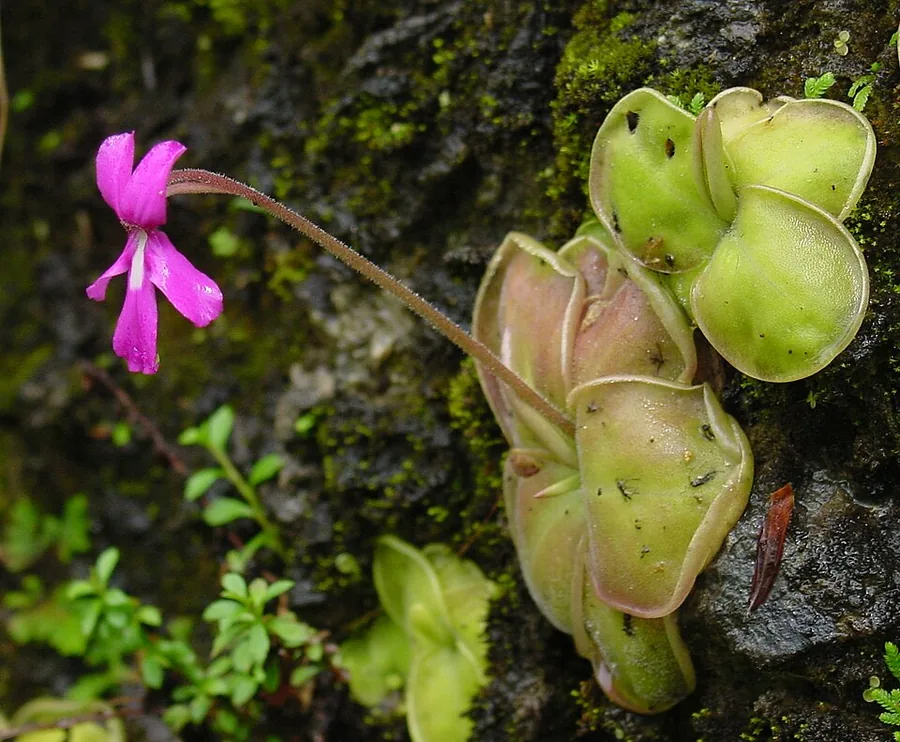
The butterwort hunts with glue, not snapping jaws, which makes it one of the most rewarding carnivorous houseplants to grow. Its flat rosette of greasy, sticky leaves grabs fungus gnats and small flies, then digests them for the nutrients its lean home soil never supplies. This Mexican species, Pinguicula moranensis, hails from volcanic country and settles right in on a bright windowsill.
One plant puts on two completely different shows across the year. From spring to autumn it fans out wide, glistening carnivorous leaves and pushes up slender stalks topped with pink-violet flowers. As daylight shrinks, it draws back into a tight, non-sticky succulent rosette and rides out winter on barely a drop of water.
The thing that catches growers off guard isn't difficulty, it's habit. Butterworts crave the exact opposite of standard houseplant care: no fertilizer, no tap water, and no rich potting mix. Nail those three and the plant practically runs itself.
Care
The short version: bright light, only distilled or rainwater, and a lean gritty mineral mix. Keep it evenly damp through the growing season, let it dry out for its winter rosette, and never feed the soil.
Light
Butterworts crave bright light, ideally bright indirect with a few hours of sun thrown in. They handle anything from full sun to partial shade, but leaves grown too dim fade pale and quit making their sticky dew.
Water
Reach only for distilled, reverse-osmosis, or rainwater, never tap, since dissolved minerals pile up and kill the plant. Keep the gritty mix evenly damp through the growing season, often by standing the pot in a shallow water tray. Through its winter rosette it wants far less, watered lightly only when the medium nearly dries.
Soil
Pot it in a gritty, low-nutrient mineral mix, think peat or long-fiber sphagnum cut with sharp sand, perlite, and a touch of pumice. Any pH from 5.0 to 7.0 does the job. Steer clear of rich potting soil completely, because these roots are wired for lean ground.
Temperature
This Mexican species stays comfortable across a wide band, roughly 41°F to 86°F (5°C to 30°C). That range makes it forgiving of everyday household swings, provided it never freezes.
Humidity
Carnivorous reputation aside, it skips the terrarium entirely. Average household humidity of 40% to 60% suits it well, and steady airflow counts for more than chasing a high reading.
Feeding
Keep fertilizer out of the soil entirely. The plant feeds itself, snagging fungus gnats and small flies on its leaves, and dropping feed into the pot only scorches the roots.
Pruning
No shaping required here. Just pick off dead, blackened, or rotted leaves along with spent flower stalks now and then, which stops fungal rot before it gains a hold.
Repotting
Repot every 1 to 2 years, best timed for spring as growth picks back up. Move it on once the mix breaks down and stays soggy, once the rosette crowds the pot edge, or once new leaves stop turning sticky.
Size & spacing
This stays a small plant, topping out at just 2 to 10 inches (5 to 25 cm) tall and spreading 3 to 6 inches (8 to 15 cm) across. A single rosette tucks neatly into a modest pot on a windowsill.
Troubleshooting
Almost every butterwort hiccup circles back to water, feeding, or the seasons. Match the signs against the list below before you act, because the knee-jerk response, like piling on water or fertilizer, usually deepens the trouble.
Crown turns black, mushy, and caves in
You are looking at crown rot, and water is nearly always the culprit. Tap or mineral water dumps salts into the lean mix, and a soggy pot during the winter rosette phase finishes the job. Swap to distilled or rainwater, flush the medium through, repot into fresh gritty mix, and trim away every soft brown patch.
Fix:
- Stop watering until the mix is barely moist
- Flush the medium with distilled/RO water to leach salts
- Repot into fresh gritty mineral mix and remove rotted tissue
- Increase airflow and light
Fresh leaves come in dry, no sticky dew
Dry, dull new growth points straight to mineral buildup or feeding. Fertilizer and rich soil scorch the roots, tap water packs the mix with salts, and weak light drags the whole plant down. Keep all feed out of the pot, flush with distilled or rainwater, and shift it somewhere that catches several hours of bright light.
Fix:
- Never fertilize the soil
- Switch to distilled/RO/rain water and flush the mix
- Move to a brighter spot with several hours of bright light
Leaves pull into tight succulent rosettes by autumn
Relax, this is the winter succulent phase and exactly what should happen. As daylight fades, the plant swaps its sticky carnivorous leaves for a compact, dry rosette and coasts through the cold. Pull back on water until the mix nearly dries, keep it in bright light, and let regular moisture return come spring.
Fix:
- Reduce watering and let the mix nearly dry
- Keep in bright light and resume normal moisture in spring
Toxicity
Households with animals can breathe easy: the butterwort is not toxic to pets or people. Its sticky leaves snare only gnat-sized insects and carry nothing harmful, so the one real reason to keep it out of reach is shielding that fragile rosette from curious paws.
Safe for
People · Cats · Dogs · Horses · Rabbits · Livestock · Birds
Cats None
Let a curious cat lick or paw the sticky leaves and the worst result is a tacky tongue. No toxin lurks here to fret over.
Dogs None
Dogs come out fine. The plant packs no poison, and a chewed leaf leaves nothing more than a greasy aftertaste.
Horses Safe
Perfectly safe around horses, though that small rosette stands no chance against a grazing muzzle.
Rabbits Safe
Harmless to rabbits. A nibbled leaf does the animal no harm, even when it sets the plant back.
Livestock Safe
Cattle, goats, and sheep run no risk. The plant holds nothing toxic, and as a tray-grown houseplant it rarely crosses their path.
Birds Safe
Birds meet no chemical hazard in the leaves or flowers. That sticky surface grabs gnat-sized insects and nothing bigger.
People Safe
Handle it bare-handed without worry; the leaf just feels greasy. This is no food plant, so nothing on it is meant for eating.
The greasy, sticky leaf surface is harmless to handle and to pets; it simply feels tacky.
Varieties
Most growers first cross paths with the butterwort through one of a handful of common forms. These are the ones you'll spot by name most often.
Pinguicula moranensis
The classic large-flowered Mexican butterwort, lifting pink-violet blooms above a flat summer rosette of greasy leaves.
Pinguicula moranensis var. neovolcanica
A recognized variety hailing from the Mexican volcanic ranges, accepted on Kew's Plants of the World Online.
Pinguicula 'Tina'
A vigorous hybrid that beginners love as an easy, gnat-catching houseplant.
How to propagate
Butterworts multiply with almost no effort, and the simplest method asks nothing more than a few leaves from a plant you already keep.
Leaf cuttingsEasy
Late winter to spring, especially from the succulent winter rosette · 4-8 weeks to form plantlets
Multiplying a butterwort comes down to leaf pulling, the quickest trick going. Gently tug whole leaves from the base in late winter or spring, while the plant sits in its succulent rosette, and lay them on damp gritty mix. Fresh rosettes sprout at the leaf base within 4 to 8 weeks.
DivisionEasy
Spring at repotting · 2-4 weeks
Mature plants love to throw offset rosettes around the parent. At spring repotting, tease these clusters apart and pot each one on its own, and they take hold within 2 to 4 weeks.
SeedDemanding
Spring on the surface of damp mineral mix · Several months to a year
Seed is the patient route. Surface-sow the fine seed on damp mineral mix in spring and sit tight, since it can take several months to a year to size up. It runs less reliably than leaf pullings, yet it pays off when you want a whole batch at once.
Myths
You have to hand-feed butterworts insects or fertilize them to keep them alive.
Those sticky leaves trap their own fungus gnats and small flies, which covers all the feeding the plant ever wants. Never fertilize the soil, because the roots evolved for lean ground and extra nutrients scorch them.
Butterworts are toxic to cats and dogs.
Pinguicula skips the ASPCA toxic plant list and counts as non-toxic to pets. The leaves catch only tiny insects and carry nothing that would hurt a curious animal.
Every carnivorous plant needs a sealed, humid terrarium.
Mexican butterworts thrive in ordinary household humidity so long as they get low-mineral water and bright light. Seal one in a case and you often invite trouble, trapping stale, rot-friendly air.