Houseplant · Zamiaceae
Cardboard Palm
Zamia furfuracea
A tough, sculptural cycad that asks for next to nothing, yet its every part is dangerously toxic.
Full sun
50–84°F · 10–29°C
USDA 9–11
2–5 ft · 0.6–1.5 m
Overview
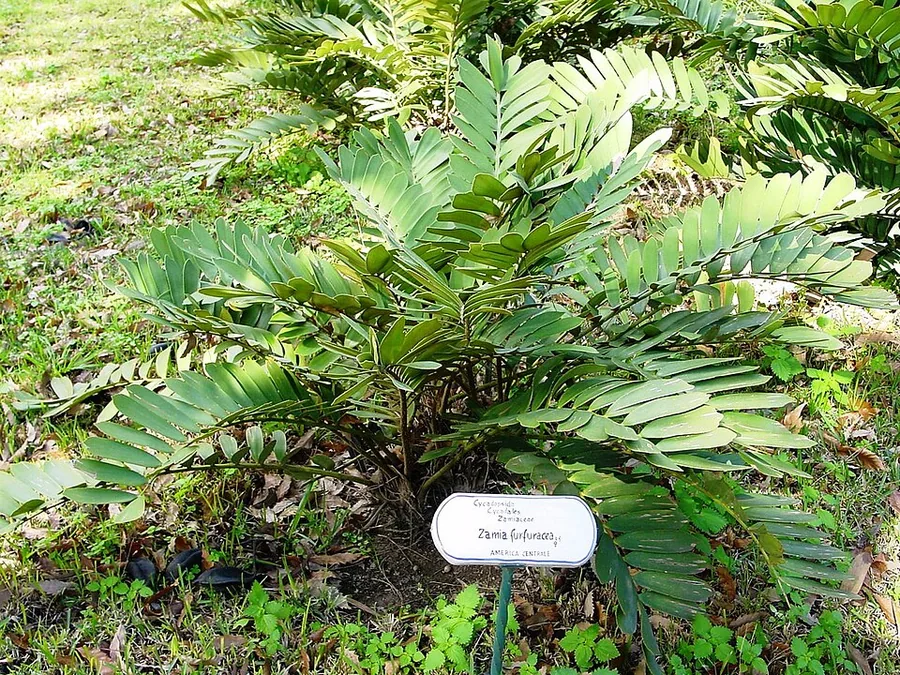
The cardboard palm picks up its name from those stiff, fuzzy leaflets that feel like thick paper, but a palm it is not. It belongs to the cycads, an ancient lineage that sits closer to conifers than to anything in the palm family, and it hails from Veracruz in eastern Mexico. Raised as a houseplant, it keeps low and wide, pushing arching fronds out from a stubby trunk year after year.
Much of its charm comes from how little it asks of you. It banks water in a tuberous underground stem, brushes off drought and salt spray, and wants only bright light and soil that drains in a hurry. The catch is patience, because this slow grower unfurls new fronds at its own unhurried pace and dislikes being moved around.
The one thing to settle before it joins your home is the hazard. Every part carries cycasin, and the bright seeds rank as the deadliest of all, with one or two enough to kill a dog. It suits a household that can park it well beyond the reach of pets and children.
Care
The short version: give it bright light, ideally full sun, plant it in sandy, fast-draining soil that you let dry out between drinks, feed it only sparingly through the growing season, and keep a sharp eye on its placement so no pet or child can get to it.
Light
Pour on as much light as you can, with full sun sitting at the top of the list. It will cope with partial sun, partial shade, or bright indirect light, but skimp too far and the fronds shoot up pale and weak while the plant tilts toward the window.
Water
Let the soil dry out completely between drinks, because the tuberous stem keeps its own reserve and rots if it stays wet. Water on a regular schedule through the growing season, then back right off and hold it on the dry side over its winter rest. Overwatering kills it faster than anything.
Soil
Set it in sandy, coarse, fast-draining soil, something along the lines of a well-drained sandy loam. Sharp drainage matters more than anything else here, since waterlogged roots are exactly what trigger rot.
Temperature
It thrives between 50°F and 84°F (10°C to 29°C) and cannot stand a hard frost. Where winters bite, that means running it as an indoor plant or hauling it inside well before the first freeze hits.
Humidity
Ordinary household humidity does the job, so there is no figure to fuss over. Hailing from a dry Mexican habitat, it takes plain indoor air completely in stride.
Feeding
Feed with a light touch, reaching for a balanced general-purpose fertilizer spread sparingly across spring and summer. Being a slow grower, it asks for very little, and overdoing it does more damage than good.
Pruning
There is barely a thing to tackle here. Snip off only the dead, damaged, or yellowed fronds down at the base, and pull on gloves every time, since every part is toxic and brushing against the seeds is worth dodging.
Repotting
Repot just every few years, since this slow grower bristles at disturbance and would rather sit a touch pot-bound. Bump it up a size once the roots crowd the pot or the plant turns top-heavy, and work the toxic tissue with gloves on.
Size & spacing
Indoors it climbs to roughly 2 to 5 feet (61 to 152 cm) tall but fans out far wider, somewhere around 5 to 8.5 feet (152 to 259 cm) across. Hand it plenty of elbow room so those broad arching fronds can spread out properly.
Troubleshooting
The cardboard palm seldom causes grief, and the two snags it does hit are simple to spot. One traces back to too much water, the other to too little light. Match what you see to the cases below and act before the plant slides downhill.
Mushy base, yellowing fronds, and a plant that topples over
You are looking at root and caudex rot, the classic result of too much water sitting in soil that will not drain. Because the tuberous stem keeps its own water supply, it turns to mush quickly once it stays wet. Stop watering right away, lift the plant out, slice off any brown, foul-smelling tissue, and settle it back into fresh sandy, fast-draining mix in a pot that has drainage holes.
Fix:
- Reduce watering immediately
- Remove from soil and cut away rotted tissue
- Repot into fresh sandy, fast-draining mix in a pot with drainage holes
Pale, stretched fronds leaning hard toward the window
This points to etiolation, what happens when a plant strains for more light. The fresh fronds arrive thin, long, and floppy rather than stiff and tight. Shift it to a brighter spot, anywhere from full sun to partial shade, and spin the pot a quarter turn every so often so it fills out evenly instead of pitching to one side.
Fix:
- Move to a brighter location with full sun to partial shade
- Rotate the plant periodically for even growth
Toxicity
This ranks among the most dangerous houseplants you can keep. It is a cycad, not a true palm, and every part packs cycasin, a toxin that goes straight for the liver. The brightly colored seeds top the list, and just one or two can kill a dog. Park it well out of reach of pets, livestock, and children, slip on gloves any time you handle it, and treat any swallowed piece as an emergency.
Toxic to
Cats · Dogs · Horses · Rabbits · Livestock · Birds · People
Cats Severe
Even one small nibble puts a cat in danger. Look for vomiting that can turn bloody, dark stools, a sudden rise in thirst, and the yellow cast of jaundice as the liver starts to fail. Without quick treatment, the outcome is often fatal.
Dogs Severe
Dogs go for both the plant and the seeds, and as few as one or two seeds can kill. Bloody vomiting, bloody diarrhea, bruising, and jaundice all signal liver damage already in motion. Race to an emergency vet the moment you spot any of it.
Horses Severe
The cycasin that strikes pets goes after a horse's liver just as hard. Count on vomiting, dark stools, jaundice, and weakness, with liver failure and death trailing behind in the worst cases.
Rabbits Severe
A rabbit physically cannot vomit a toxin this potent back up, which makes any bite swallowed especially deadly. The cycasin sets off the same liver injury other animals face, so keep the plant completely beyond their reach.
Livestock Severe
Grazing cattle, goats, and sheep all face genuine danger, and cattle take on an added unidentified neurotoxin alongside the cycasin. Liver failure and death can follow, so never let stock browse the fronds or any fallen seeds.
Birds Severe
A curious bird that pecks a frond or a bright seed swallows the same liver toxin everything else does. Their tiny bodies mean a little goes a long way, so keep cages and perches well away from the plant.
People Caution
Nothing about this plant belongs on a plate. Children face the greatest risk from the colorful seeds, and swallowing any part can wreck the liver, so handle it in gloves and treat any ingestion as a true medical emergency.
Keep well out of reach of pets and children; wear gloves when handling, pruning, or repotting, and avoid contact with the brightly colored seeds. Dispose of trimmings and fallen seeds where animals cannot reach them.
Helpline numbers

United States
ASPCA Animal Poison Control: (888) 426-4435 (fee applies)
Poison Control: (800) 222-1222



Canada
Poison Centres: 1-844-764-7669
Varieties
Cardboard palm shows up almost entirely as the wild species, and the female plant is the one most people picture when they hear the name.
Zamia furfuracea (species, female)
Female plants are the showstoppers, carrying a bold reddish-orange seed cone crammed with bright fleshy seeds, while the stiff arching fronds sport the coarse, fuzzy, cardboard-like leaflets that hand the plant its name.
How to propagate
Two routes lead to more cardboard palms, both on the slow side and both calling for care because the seeds and tissue are toxic. Neither moves fast, so this one rewards a patient grower.
SeedModerate
When ripe seed is available, sown in a warm, well-draining medium · Several months to over a year; germination and growth are slow
Ripe seed sown into a warm, well-draining mix will grow you fresh plants, though it really stretches your patience, with germination and early growth inching along over several months to more than a year. The seeds pack the heaviest dose of cycasin of any part of the plant, so pull on gloves before you sow and keep them far from pets and children.
Offsets & pupsModerate
Growing season, by separating offsets from the parent · Several months as a slow grower
Through the growing season you can sometimes detach offsets, those little pups that sprout around the base, and pot each one up alone. Give them several months to root in, and rough up the roots as little as possible, since this slow grower resents being moved.
Myths
Since it is called a cardboard palm, it must be a real palm and harmless like the rest of them.
The name misleads: this is a cycad, not a palm, and the difference is no trivia. Every part is loaded with cycasin, and a curious pet or child who swallows even a seed or two can face fatal liver failure. Give it the same wary respect you would give a sago palm.