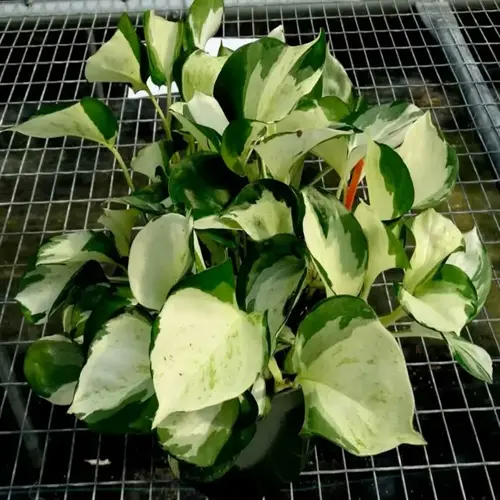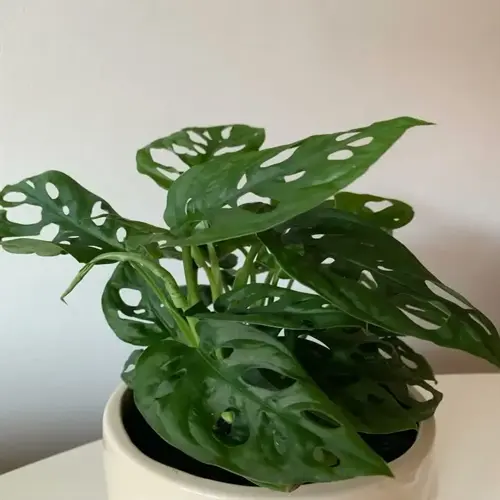

Introduction
Here is the first thing to know about your satin pothos. It is not a pothos at all. The shop tag and the plant police online both call it one, but its real name is Scindapsus pictus, and that small fact changes how you should treat it. Get the identity right and the rest of the care falls into place fast.
I pulled mine off a garden center shelf with a tag that just said "pothos" in marker. The leaves gave it away. They have a soft, matte finish splashed with silver, which is why people also call it silver pothos. It trails over a shelf or climbs a pole with equal ease, and it sits near the top of every list of silver-leaved houseplants. Stores mislabel it as a pothos or a philodendron all the time, so plenty of owners care for it wrong without knowing it.
Two questions about this plant rarely get a straight answer. Why is it toxic, and how big does it really get? NC State Extension settles the size with a clear number. Indoors it stays a slow grower at about 1.5 to 3 feet, and it only stretches to 10 feet tall and 4 feet wide in the wild. This guide answers both questions with sources you can check.
Here is what you will walk away with. You will learn the right bright indirect light, watering, and soil setup. You will be able to tell a true pothos from this one at a glance. You will know how tall it climbs and when to give it a pole. You will see why it is toxic to cats, dogs, and horses, and what to do about it. And you will fix yellow or curling leaves before they spread. Let's start with satin pothos care that holds up.
Satin Pothos At A Glance
Think of this block as the plant tag you wish came in the pot. It gives you the essentials of good satin pothos care before you reach the deeper detail in later sections. Skim it once, then come back to it any time you forget a number.
The headline facts are short. Scindapsus pictus wants bright indirect light and no direct sun. Keep it warm, between 65 and 85 degrees Fahrenheit (18 to 29 degrees Celsius). Water only when the top inch (2.5 cm) of soil feels dry, and plant it in a well-drained soil that runs acidic, below a pH of 6.0.
Size sets your patience. This is a slow grower that tops out around 1.5 to 3 feet (0.5 to 0.9 m) indoors, so it stays neat on a shelf for years. The acidic soil below pH 6.0 matters too, and most peat-based houseplant mixes already land in that range.
The good news for new owners is how forgiving this plant is, which is why so many people call it an easy first houseplant. It shrugs off a missed watering and recovers fast. The one thing you cannot fudge is light. I moved one of my own plants from a bright window to a dim corner, and the new leaves came in with far less silver. Keep it bright and the satin look holds.
Light, Water And Soil Needs
| Need | What To Provide | What To Avoid |
|---|---|---|
| Light | Bright indirect light near a window | Direct sun that scorches and fades variegation |
| Water | Water when the top inch (2.5 cm) of soil is dry | Keeping soil soggy, which causes root rot |
| Soil | Acidic (below pH 6.0), well-drained, organic-rich mix | Dense, water-holding soil with no drainage |
| Temperature | 65 to 85°F (18 to 29°C), away from drafts | Cold drafts and temperatures below the comfort range |
| Care figures from NC State Extension and Missouri Botanical Garden. | ||
I carried my 'Argyraeus' off the dim bathroom windowsill and set it in a bright south window so the silver would pop. Two weeks later the silver had faded to a dull green. The leaf edges turned crisp and brown. I moved it back to the bathroom sill and gave it a drink. Within a month the silver came roaring back and the burnt edges stopped spreading.
That south window taught me what the books say about this plant. A satin pothos wants bright indirect light near a window with no direct sun on the leaves. Direct rays fade the variegation and burn the foliage, so a spot a few feet back from a bright window works far better than the glass itself.
Water is where most people get into trouble, and it goes the opposite way you might think. Overwatering, not underwatering, is the fastest way to harm this plant. So how often to water satin pothos comes down to one simple test. Stick a finger in the pot and water only when the top inch (2.5 cm) of soil is dry. Soggy soil suffocates the roots and leads straight to root rot, which is hard to undo once it sets in.
Drainage matters as much as your watering habits. Always use a pot with drainage holes so extra water can escape. Empty the saucer after every watering and never let the pot sit in a puddle. Let the soil dry out a little between drinks and your plant will thank you with firm, healthy roots.
The soil itself should be acidic soil below pH 6.0, moist but well-draining soil that is rich in organic matter. A simple aroid-style mix does the job. Blend regular potting soil with perlite and a handful of orchid bark. That mix holds a little water, lets the rest run off, and stays on the slightly acidic side these plants prefer.
Temperature rounds out the basics. Keep your satin pothos between 65 and 85 degrees Fahrenheit (18 to 29 degrees Celsius) and away from cold drafts. It is a tropical plant at heart, so chilly windowsills in winter and blasts from an air vent will set it back. Get the light, water, soil, and warmth right and the rest of its care falls into place.
Letting the pot sit in standing water is the fastest way to kill a satin pothos. Always use a pot with drainage holes and empty the saucer after watering.
How To Identify Satin Pothos
The first thing to know is that this plant is Scindapsus pictus, and it sits in its own genus. It is not a true pothos, which belongs to Epipremnum, and it is not a philodendron either. So the whole satin pothos vs pothos debate comes down to one simple fact. The name on the tag is wrong, but the plant is still lovely.
Botanists first described the species back in 1842, and the word pictus means painted. That name fits, because the silver markings look like someone brushed them on by hand. Juvenile leaves run about 3 to 4 inches (7.5 to 10 cm) long. They are matte green to dark green, dressed with silver-gray blotches across the surface.
The quickest way to spot it in a shop is the finish. A satin pothos leaf is matte, and the silver catches light like brushed metal. A true pothos leaf shines and looks glossy instead. Run your eye across the surface and you will see the difference in a second.
Now you can tell the satin pothos varieties apart. Argyraeus has small leaves with neat, even silver spots. Exotica shows larger leaves with broad silver splashes. Silvery Ann goes the furthest. Its heavy silver almost hides the green below.

Scindapsus pictus Argyraeus
- Leaves: Small to medium matte green leaves dotted with crisp, even silver-gray spots that give a tidy, speckled look.
- Size: A compact, slow-growing trailing plant that fits well on a shelf or in a small hanging pot indoors.
- Recognition: The neat, contained silver markings are the easiest way to tell this classic cultivar apart from broader-splashed types.
- Habit: Trails with ease but will climb a moss pole, where its leaves grow much larger over time.
- Availability: One of the most widely sold satin pothos cultivars, so it is usually the easiest to find and the most affordable.
- Care: Same as the species, wanting bright indirect light and water when the top inch (2.5 cm) of soil is dry.
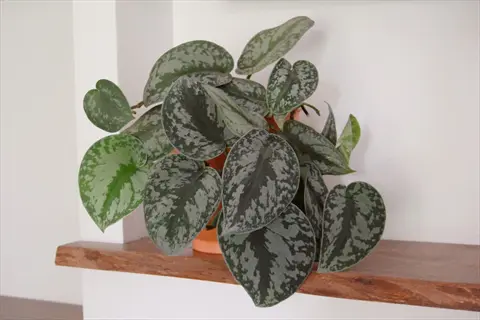
Scindapsus pictus Exotica
- Leaves: Larger, broader leaves with wide, brushed silver splashes that cover much more of the leaf surface than Argyraeus.
- Size: Still a slow grower, but the bigger leaves make it a striking feature plant once established indoors.
- Recognition: The dramatic, spread-out silver patches are the giveaway, often making this the most photographed cultivar.
- Habit: Climbs well on a support, where the already-large leaves expand further and shingle toward the light.
- Availability: Common in plant shops, though sometimes priced a little higher than Argyraeus for its showier look.
- Care: Identical needs to the rest of the species, with bright indirect light keeping the silver bold and clear.
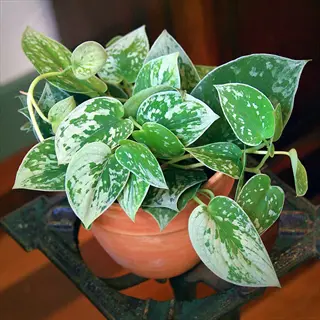
Scindapsus pictus Silvery Ann
- Leaves: Heavily silvered leaves where the silver can cover most of the surface, leaving only thin green edges and a green midrib.
- Size: A modest, slow-growing trailer like its relatives, prized more for color than for fast coverage.
- Recognition: The near-solid silver wash sets it apart, making it look almost frosted compared to spotted cultivars.
- Habit: Trails or climbs the same way, with the heavy silver staying vivid in good bright indirect light.
- Availability: Popular among collectors and more common each year, though still less abundant than Argyraeus.
- Care: Needs the same acidic, well-drained soil and careful watering as every other satin pothos.
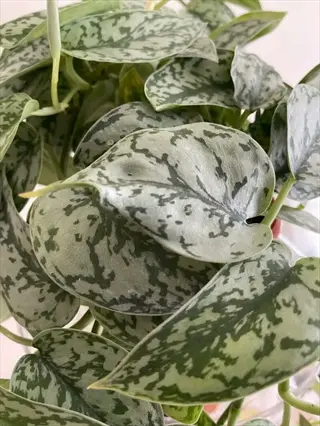
Scindapsus pictus Silver Lady
- Leaves: Soft, pale silvery-green leaves with a gentle, diffuse variegation that looks lighter and frostier than the bold splashes of Exotica.
- Size: A small, slow-growing trailer, valued for its delicate coloring rather than for quick or large growth.
- Recognition: The muted, almost silvery overall tone, with less sharp contrast, separates it from the spotted and heavily splashed cultivars.
- Habit: Trails neatly from a shelf or climbs a small support like the rest of the species, staying compact indoors.
- Availability: Less common than Argyraeus and Exotica, so it is more of a collector pick when you find it in shops.
- Care: Wants the same bright indirect light, acidic well-drained soil, and careful watering as every satin pothos.
Shops sell this plant under a pile of names, so do not let the label throw you. You will see it tagged as silver pothos. You will also see silver vine or silver satin pothos, and the cultivar name often gets dropped. Knowing the leaf shape and that brushed-metal sheen lets you buy the plant you want, no matter what the sticker says.
Size, Growth And Climbing
My 'Exotica' climbs a moss pole in my living room, and after three years its leaves are the size of my palm. My 'Argyraeus' on the bathroom sill has trailed the whole time, and its leaves stayed small, maybe the length of my thumb. Same plant type, same three years, two very different looks for you to copy. I added the moss pole to my 'Exotica' on a whim, just to keep a leggy stem off the floor. The vine grabbed on with little rootlets and never looked back.
So how big does satin pothos get in your home? It depends on where you grow it. In its native habitat it climbs tree trunks and reaches up to 10 feet (3 m) tall and 4 feet (1.2 m) wide, clinging with rootlets the whole way up. Indoors you will see a much smaller plant. Yours will likely stay between 1.5 and 3 feet (0.5 to 0.9 m), and it takes a few years to mature to roughly 3 feet (1 m).
Some sources online call this a fast plant, but the authorities disagree. NC State Extension and Missouri Botanical Garden both list it as a slow grower, slow to moderate at best. Your satin pothos growth rate hinges on light and support. Give it bright indirect light and something to climb, and it speeds up. Stick it in a dim corner and it will crawl along for months.
Grown up a moss pole, the vine clings with rootlets like it would on a tree trunk, and its leaves grow noticeably larger and more dramatic over time.
Left to trail from a shelf or hanging pot, it stays tidy with smaller leaves, which is the look most people picture when they buy a satin pothos.
In its native habitat, this plant climbs on tree trunks, supported by rootlets, and reaches a height up to 10 feet tall and 4 feet wide.
The leaf-size trick comes down to climbing versus trailing. When the vine climbs a moss pole, it mimics how it grows up tree trunks in the wild, so the leaves get bigger and more dramatic. Let it trail from a shelf and the leaves stay small and tidy. Want larger foliage? Give it a pole to grab. Want a neat hanging look? Let it spill over the edge.
Is Satin Pothos Toxic?
So is satin pothos toxic? Yes. The ASPCA lists it as toxic to cats, dogs, and horses, and most care guides note this in a single line and move on. You deserve more than that, so here is what actually happens and what you should do about it.
The trouble comes from insoluble calcium oxalates packed inside the plant's cells. These are tiny crystals, and the same irritating compound shows up across the whole arum family, not just this one plant. They are not a poison your pet's stomach has to break down. They hurt on contact.
The crystals come in needle shapes called raphides. A curious cat or dog bites a leaf and crushes the cells. Water floods in. Those sharp needles then get driven straight into the soft tissue of the mouth and throat. Think of them as microscopic glass needles fired off by a single bite. That is why the burning starts at once instead of hours later.
Which Animals Are At Risk
- Pets affected: The ASPCA lists satin pothos as toxic to dogs, cats, and horses, so it is not a safe choice for homes where animals can reach it.
- Why it happens: The toxic principle is insoluble calcium oxalates, the same irritating crystals found across many plants in the arum family.
- Risk level: Reactions are usually localized to the mouth and throat and tend to be mild, but they are painful and distressing for the animal.
Signs Of A Reaction
- Mouth symptoms: Expect oral irritation with intense burning and swelling of the mouth, tongue, and lips soon after a pet chews the plant.
- Other symptoms: Excessive drooling and difficulty swallowing are common, and dogs and cats may vomit, though horses tend not to.
- Onset: Symptoms come on fast because the crystals injure tissue on contact rather than needing to be digested first.
How The Crystals Injure Tissue
- Mechanism: Chewing breaks plant cells, water rushes in and swells them, and sharp needle-shaped raphides are forced into the soft tissue of the mouth and throat.
- Effect: This physical stabbing causes the immediate burning pain, which stops most animals from eating a large amount.
- Context: Roughly one in four plant-poisoning cases referred to a Hong Kong toxicology lab from 2003 to 2017 involved calcium oxalate raphides, showing how common this irritant is.
What To Do
- Prevention: Place the plant on a high shelf or in a hanging pot well out of reach of curious pets and small children.
- If a pet chews it: Rinse the mouth gently, watch for swelling, and contact your veterinarian; the ASPCA Animal Poison Control Center is reachable at (888) 426-4435.
- Safer setup: If you keep pets that climb or chew houseplants, treat this plant as a look-but-do-not-touch display rather than a floor-level one.
Here is the reassuring part. The pain hits the second a pet bites down, so most animals stop fast. That means large amounts are uncommon and reactions tend to stay mild. I still moved my own plant to a high shelf after my cat took one curious nibble and backed off with a sour face. Keep yours out of reach too. Call your vet or the ASPCA line at (888) 426-4435 if a pet chews it. And skip the air-purifying claims you may have read, since that research used golden pothos, not this plant.
Damage to the plant cells during chewing causes water to enter and swell up the cells. This stimulates the forceful propulsion of the sharp raphides into the surrounding environment, stabbing the sensitive tissues of the tongue, gums and throat and resulting in tissue injuries in the oral cavity.
Common Problems And Fixes
Almost every issue you'll run into traces back to two things, water and light. This is a tough plant with no serious pests or disease. So a sad-looking plant points to a simple care slip, not a real bug problem.
The fastest fix is to match the symptom to its most likely cause. Satin pothos yellow leaves are a sign you give it too much water. Leaves curling point the other way, toward a thirsty plant. Soggy soil that never dries out leads to root rot, and dry air or uneven watering shows up as brown tips on the edges.
Pests are rare here, but check the undersides of leaves if growth looks off. Spider mites leave fine webbing and tiny speckles, and a quick wipe with insecticidal soap clears them before they spread. Use the table below to self-diagnose at a glance.
One symptom catches new owners off guard. If the silver markings fade and growth slows to a crawl, the plant isn't dying, it just wants more light. Too little light dulls the variegation, so move it to a spot with bright indirect light and both the color and the vigor come back over a few weeks.
Correct the basics and this plant bounces back fast. Steady watering, decent drainage, and the right amount of light fix the vast majority of problems you'll ever see.
5 Common Myths
Satin pothos is just another type of true pothos, so it belongs in the same Epipremnum genus as golden pothos.
It is Scindapsus pictus, a completely separate genus. It is neither a true pothos nor a philodendron, despite the shared common name.
Satin pothos purifies the air in your home, so a few plants can noticeably clean the air you breathe.
The famous clean-air study tested golden pothos in sealed chambers, not satin pothos in homes. Real-world air purification by houseplants is not established.
Because it tolerates lower light, satin pothos grows fine in a dim corner and never needs brighter conditions.
It survives lower light but loses its silver variegation and grows slowly. Bright indirect light keeps the markings vivid and growth steady.
Satin pothos must be misted several times a day or it will dry out and quickly drop its leaves.
Misting only raises humidity briefly. Steady humidity from a pebble tray or humidifier matters far more than frequent misting for this plant.
Satin pothos is harmless, so it is a safe choice to place anywhere within reach of curious pets and children.
It is toxic to cats, dogs, and horses. Its calcium oxalate crystals cause oral pain and swelling when chewed, so keep it out of reach.
Conclusion
Good satin pothos care comes down to a few habits you can repeat for years without much thought. You now know how to spot the real plant, where to set it, and when to reach for the watering can. That foundation is all a beginner needs to grow this plant well.
Start with the name. Scindapsus pictus is not a true pothos at all, and that single fact shapes everything else you do for it. Give it bright indirect light so the silver dusting on each leaf stays bold, and never park it in a sunny window. Then water only when the top inch of soil feels dry, since soggy roots cause more trouble than a few dry days ever will.
Keep your size expectations grounded too. This is a slow grower that climbs to 10 feet in the wild but settles in at 1.5 to 3 feet (0.5 to 0.9 m) indoors over several years. One thing every home with pets must respect is its toxicity. The plant is toxic to dogs, cats, and horses. Its tissue holds insoluble calcium oxalates, the sharp crystals that sting a mouth that chews a leaf. Keep it up high or behind a closed door, and save the ASPCA poison control line just in case.
The trade with this plant is simple. You give it time, and it gives you a bolder silver pothos crown that gets more striking with each new leaf. I moved one of mine onto a moss pole last spring, and the new leaves came in noticeably wider within a few months. Try the same. Slip a moss pole into the pot, shift it to a brighter corner, and watch how the leaves widen and reach. Few houseplants pay you back this well for this little daily effort.
Glossary
- aroid-style mix
- A chunky, fast-draining potting blend of soil, perlite, and bark suited to plants in the arum family.
- Bright indirect light
- Strong daylight that reaches a plant without the sun's rays falling directly on its leaves.
- Insoluble calcium oxalate
- Sharp, needle-shaped crystals in the plant that do not dissolve in water and irritate the mouth when chewed.
- Raphides
- The needle-shaped form of calcium oxalate crystals that physically stab mouth and throat tissue on contact.
- Root rot
- Decay of a plant's roots caused by soil that stays too wet, which suffocates the roots.
- Scindapsus pictus
- The botanical species name for satin pothos, a trailing tropical vine in the arum family that is not a true pothos.
- Variegation
- The silver-gray markings on a leaf, caused by patches that reflect light differently from the green tissue.
- well-drained soil
- A potting mix that lets excess water flow out quickly so the roots never sit in soggy soil.
External Sources
Frequently Asked Questions
Is satin pothos really a pothos?
No. It is Scindapsus pictus, a separate genus from true pothos (Epipremnum) and from philodendron.
Are satin pothos easy to care for?
Yes. They are forgiving plants that mainly need bright indirect light and water only when the top inch of soil is dry.
Do satin pothos need sunlight?
They need bright indirect light. Direct sun scorches the leaves and fades the silver markings.
How often do you water a Satin Pothos?
Water when the top inch of soil feels dry, often roughly weekly in summer and less in winter.
Do satin pothos like to climb or hang?
Both. They trail beautifully but grow larger leaves when climbing a support like a moss pole.
What is the lifespan of a Satin Pothos?
It is a long-lived evergreen vine. With steady care it lasts many years, and cuttings keep it going indefinitely.
What are the disadvantages of pothos plants?
Main drawbacks are:
- Toxic to cats, dogs, and horses
- Slow growth indoors
- No proven air-purifying benefit
What are the common Satin Pothos problems?
Common issues are:
- Yellow leaves from overwatering
- Curling leaves from underwatering
- Brown tips and root rot from soggy soil
Why is pothos called the devil's ivy?
Golden pothos is called devil's ivy for being nearly impossible to kill. Satin pothos is a separate Scindapsus species.
Do Satin Pothos like to be misted?
Not really. Misting is brief and optional; steady humidity from a tray or humidifier helps more.